4 Questions that Simplify Social Security Benefits
March 8, 2018

Key Takeaways
- A few key questions can make Social Security far less intimidating for clients: understanding full retirement age, when they're eligible to collect, whether they can work while receiving benefits, and how to think about life expectancy.
- Claiming age has a major impact on lifetime benefits. Claiming early means reduced payments, full retirement age (66-67) is neutral, and waiting until 70 maximizes delay credits, a difference that can add up to hundreds of thousands of dollars over a retirement.
- The right software turns these conversations into clear visuals. RightCapital allows advisors to model and optimize Social Security claiming strategies as soon as a plan is created, helping clients see the long-term impact of their choices.
It’s highly likely your clients have questions about retirement and more specifically around social security. But they may not be sure what to ask except for “when can I retire?” and “when should I collect?” It’s never too early to talk to your clients about retirement and a quick conversation about key areas of concern can be a great spring board into a discussion around long term financial goals and retirement planning.
Here are some key questions to review with your clients so that they can finally stop wondering ‘when is the right time to start collecting social security benefits?'
What exactly is Full Retirement Age?
While some clients may feel they are ready to retire at age 40, full retirement age is actually between the ages of 66 and 67, depending on when the person was born. It’s essential both you and your client know their full retirement age as this directly affects when they should start collecting benefits and the amount they will receive.
When are my clients eligible to start collecting benefits?
Your clients can start taking benefits as early as age 62 or as late as age 70 but remember, benefits are reduced or maximized depending on age. Here are a few age dependent scenarios for clients to keep in mind:
Scenario 1: Take benefits as early as possible at age 62
Start receiving benefits as early as possible, incurring early start penalties. Your clients will receive more payments in the early years, but they will pay a penalty.
Scenario 2: Wait until Full Retirement Age
No penalty nor delay credit. Consider this a neutral option.
Scenario 3: Wait until age 70
Delaying as long as possible to receive benefits will maximize the delay credit. If your clients can wait until age 70, they will reap the rewards.
Strategy | Total Benefit | Difference |
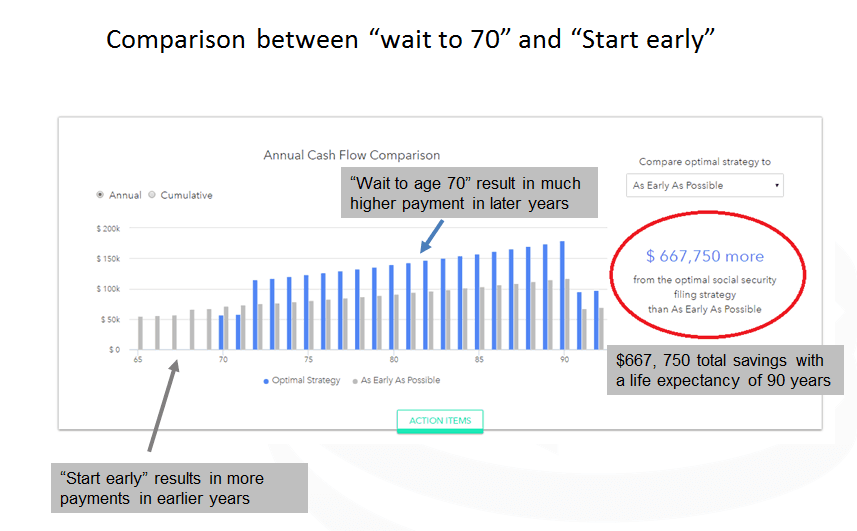
Age 62; Start receiving benefits as early as possible, incurring early start penalties | $2,384,201 | |
Age 67; Wait until full retirement age, no penalty and no delay credit | $2,718,649 | +$334,448 |
Age 70; Delay as long as possible to maximize the delay credit | $3,051,951 | +$667,750 |
(Assumes life expectancy of 90 and 2.5% annual Social Security COLA)
This chart outlines what may happen to your clients benefits in all three of these scenarios outlined above. It’s an easy visual way to show how taking benefits later can account for more savings and ultimately more payments in the long run. But your client would have to be comfortable taking payments later.
What if my clients want to work and receive benefits?
Totally fine. If your clients are able to work until they reach retirement age, this is a great way to potentially increase their benefits in the long run.
How do I define life expectancy ?
This is a tough question to answer because, let’s face it, you cannot tell the future. No one knows how long they will live. So, it’s more a question of what makes your clients feel more secure: a smaller benefit sooner, or a larger benefit later.
Educate and communicate
Retirement and social security are complex topics, but there are ways to make these subjects less intimidating for clients and prospects alike. Start your conversations with clients early and review common terminology and questions so they feel educated and ready to discuss their options. Then show clients what an optimized Social Security Strategy looks like for their retirement goals but utilizing a software like RightCapital. Our intuitive and interactive financial planning software allows you to begin Social Security optimization conversations as soon as plans are created.
Want to learn more about our #1 user rated software? Schedule a demo today and get your free trial.
%3Aformat(webp)&w=3840&q=75)
%3Aformat(webp)&w=3840&q=75)
%3Aformat(webp)&w=3840&q=75)