9 Estate Planning Software Tools Financial Advisors Use for Comprehensive Client Plans in 2026
September 17, 2026
Key Takeaways
- 84% of advisors include estate planning in client financial plans and 58% handle this work internally, per the Kitces Report (March 2025).
- The category splits three ways. Comprehensive planning platforms model estate outcomes inside the broader plan, document creation platforms produce the wills and trusts, and analysis tools read or map what a client already has.
- Start with the financial planning platform. It's where the estate conversation begins and where trade-offs get modeled against the client's existing plan data.
- Check what's included versus what's an add-on. Advanced trust modeling sits behind a premium tier at some platforms and comes standard at others.
Estate planning has moved from a nice-to-have to a core part of most service models. According to the Kitces Report "How Financial Planners Actually Do Financial Planning" (March 2025), 84% of surveyed advisors now include estate planning in their clients' financial plans and 58% handle it internally rather than referring it out.
Doing that work well is another story. Many advisors are stitching it together across disconnected tools (a spreadsheet for beneficiary tracking, a separate platform for documents, a standalone trust modeler) which means duplicated data entry, manual errors in complex estate structures, and client conversations that are harder to illustrate than they should be, particularly when the client's real question is what happens to their loved ones after they pass.
Worth saying up front: the fix is sometimes more than one tool. Modeling what an estate plan produces is a different job from creating the documents that make it real, and the latter often requires an estate attorney. The right estate planning technology depends on which you're solving for, and a financial planning platform paired with a document provider is a normal stack.
9 estate planning tools for financial advisors
The nine estate planning software tools below fall into three broad categories. Comprehensive planning platforms connect retirement, tax, and investment strategies to estate modeling. Dedicated estate document creation and management platforms focus on drafting, storing, and maintaining wills, trusts, and related paperwork. Visualization tools specialize in turning complex estate structures into flowcharts and diagrams clients can easily follow.
Most practices end up using tools from more than one category. Review the summaries and key features below to find the combination that fits your workflow best.
Estate Planning Tool | Type of Tool | T3 Ratings (March 2026), Estate Planning | Estate Capabilities Access |
|---|---|---|---|
RightCapital | Financial planning software | 7.63/10 (8.52/10 overall) | Included with every pricing tier |
eMoney | Financial planning software | 7.8/10 (8.22/10 overall) | Included with every pricing tier |
MoneyGuide | Financial planning software | 7.48/10 (7.67/10 overall) | Included with WealthStudios add-on |
Vanilla | Dedicated estate planning and document platform | 7.23/10 | Dedicated tool |
Wealth.com | Dedicated estate planning and document platform | 8.24/10 | Dedicated tool |
Trust & Will | Dedicated estate planning and document platform | 7.41/10 | Dedicated tool |
EncorEstate Plans | Dedicated estate planning and document platform | 8.47/10 | Dedicated tool |
Asset-Map | Visualization tool | N/A (7.3/10 overall) | Included with every pricing tier |
FP Alpha | Dedicated estate and tax planning platform | 7.87/10 (7.81/10 overall) | Dedicated tool |
RightCapital
RightCapital is a comprehensive financial planning platform that empowers advisors to integrate estate planning seamlessly into holistic and comprehensive client plans. The software offers intuitive visualizations, scenario modeling, and robust integrations, making it easy to address complex estate and legacy needs alongside retirement, tax, and investment strategies. Estate features are included in every pricing tier with no add-on needed.
Key estate planning features:
- Estate planning inside the same client plan as retirement, insurance, annuity, tax, and business strategy modeling
- Robust estate proposal adjustments, including customizing age of passing, probate fees, deceased spousal unused exclusion (DSUE) amounts, and cumulative gift tax paid
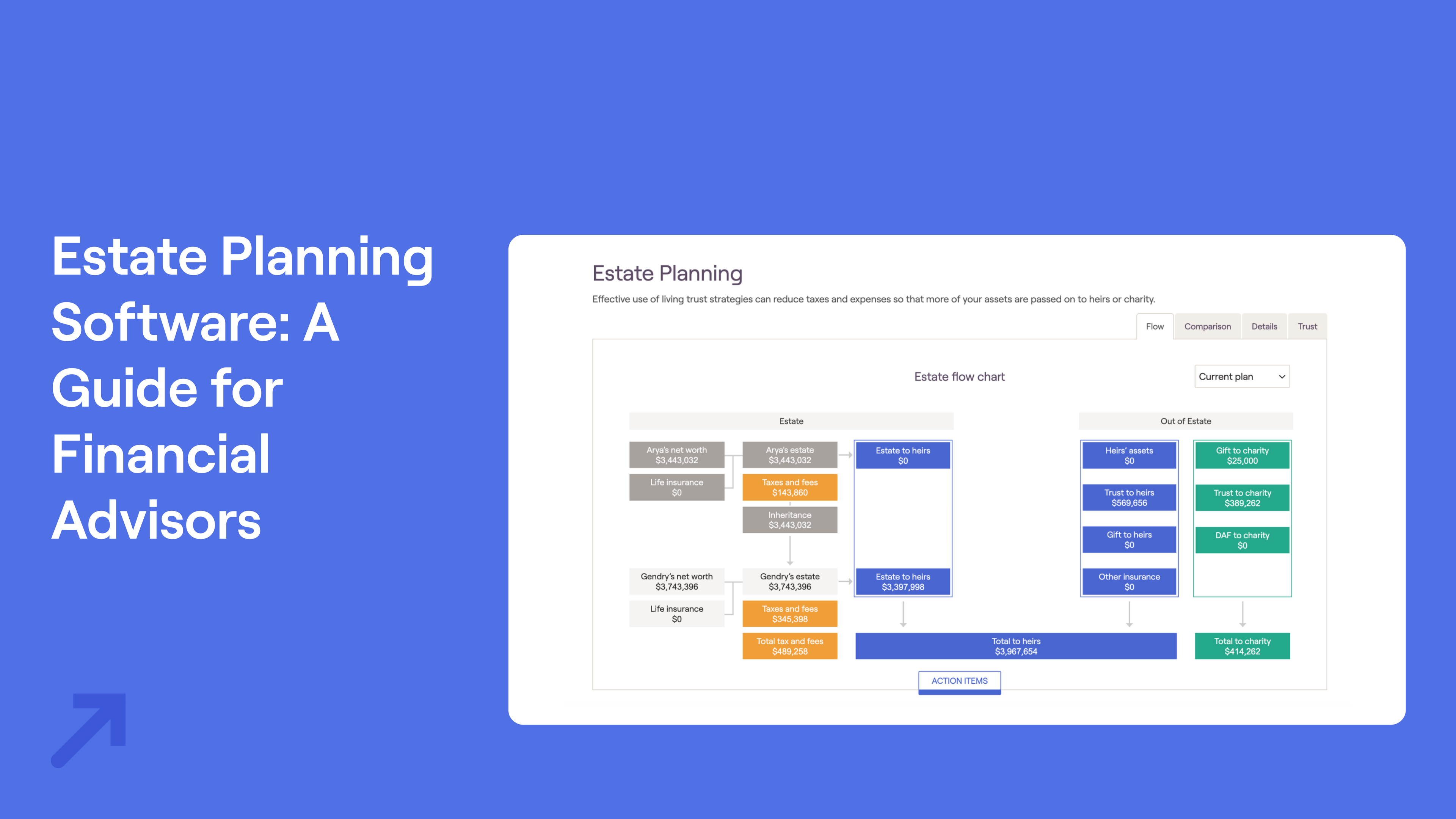
- Estate flow chart mapping asset movement at each death, separating taxable from out-of-estate assets, surfacing federal and state estate tax, amounts to heirs, and charitable transfers
- Trust and entity modeling across 10+ types—credit shelter (CSTs), charitable remainder (CRTs), charitable lead (CLTs), irrevocable life insurance (ILITs), spousal lifetime access (SLATs), qualified terminable interest property (QTIPs), qualified personal residence (QPRTs), grantor retained annuity (GRATs), intentionally defective grantor (IDGTs), and irrevocable grantor trusts—can be added as part of the existing net worth or as trust proposals and toggled on or off with a click to see the impact instantly
- Comparison tab showing current versus proposed plans side by side with assets to heirs, charitable giving, total taxes and fees, and retirement income
- Trust tab with trust cash flow level projections of annual balances, portfolio returns, taxes and fees, and distributions for each trust, exportable to CSV
- Customizable checklist to keep track of estate planning documents such as power of attorney, and recording space for beneficiary designations across bank/investment/retirement accounts and life insurance policies
- Secure document Vault to easily store wills, trusts, and legal documents
- Iris, AI financial planning agent, to answer questions related to the plan on estate and the full financial picture (included in Premium and Platinum subscriptions)
eMoney
eMoney is a comprehensive planning platform first, and its estate capability lives inside the cash flow engine. eMoney models what a client's existing plan actually produces—running assets through both deaths, applying transfer taxes and costs, and showing what lands with heirs. Advisors can add wills, gifts, and charitable bequests as planning techniques and compare the result against the client's current situation side by side. Compare eMoney and RightCapital in this dedicated article.
Key estate planning features:
- Estate planning inside the same client plan as retirement, tax, and cash flow modeling
- Estate Flow Chart
- Estate Transfer reports
- Scenario modeling for multi-generational legacy planning
- Secure document vault for estate planning documents
MoneyGuide
MoneyGuide is a goals-based planning platform, and estate sits in it at two levels. The higher subscription tier, Wealth Studios, covers the basics of estate projections plus modeling out GRATs, IDGTs, charitable trusts, entity-level ownership, and multi-generational transfers, along with a family tree view of where assets land. Compare MoneyGuide and RightCapital in this blog post.
Key estate planning features:
- Estate planning inside the same client plan as retirement and goal funding
- Estate tax projection
- Estate flow charts
- Bypass trust, ILIT, and gifting strategies modeled against the goal plan
- Side-by-side scenario comparison
- Annual gift tracking and trust growth visibility across the plan
- Family Tree view of assets flowing to heirs and entities at each projected death (Wealth Studios add-on)
- Advanced trust and entity modeling, including GRATs, IDGTs, charitable trusts, Crummey provisions, gift splitting, and business sale scenarios (Wealth Studios add-on)
Vanilla
Vanilla is an estate planning platform aimed at advisory firms. Advisors can upload a client's existing wills and trusts and get back a visual breakdown of what's actually in them, including provisions that have gone stale. Depending upon the advisor’s subscription package, that review can be handled by estate planning attorneys Vanilla employs directly. The platform is designed for advisors without a legal background, and it scales from straightforward plans up to complex multi-entity structures.
Key estate planning features:
- V/AI, an AI estate focused planning assistant that pulls data out of uploaded documents, drafts plan summaries, and answers estate planning questions on demand
- Estate Health Check, a questionnaire that flags gaps and unaddressed opportunities across an advisor's full client base
- Document Builder, guided workflows that walk clients through creating foundational estate documents
- Scenarios, side-by-side modeling of advanced strategies such as GRATs, SLATs, and charitable vehicles
- Attorney-led review that converts existing paperwork into visual summaries
Wealth.com
Wealth.com emphasizes that estate and tax work belong in the same system, running continuously instead of surfacing once a year at filing time. Clients gain access to a portal for uploading paperwork, connecting accounts, and reviewing reports. Advisors can use Wealth.com with a range of client types, covering a first set of basic documents through to multi-generational trust structures.
Key estate planning features:
- Ester®, an AI engine that reads uploaded estate and tax documents and converts them into summaries, structured data, and visual breakdowns
- Document generation for revocable trusts and pourover wills, standalone wills, financial powers of attorney, health care directives, and guardianship nominations, tailored to state requirements
- Scenario Builder, which runs proposed strategies alongside a client's existing plan to project tax and estate distribution outcomes
- Vault, for keeping executed documents in one place and sharing them selectively
- Permissioned access for the other professionals in a client's orbit—estate planning attorneys, CPAs, and similar
Trust & Will
Trust & Will started as a direct-to-consumer product, an online, self-guided flow that walks an individual through building a will or a revocable living trust in a single sitting. That same engine backs an advisor channel, giving practices a low-friction way to complete foundational documents for clients with nothing in place. It's a narrower tool than the platforms above: strong on getting documents created and maintained, not built for modeling advanced transfer strategies or tax outcomes.
Key estate planning features:
- Three tiers: a free option that allows advisors to give their clients a custom discount on estate plans, a growth tier covering 25 estate plans, and a premium plan for more than 25 estate plans
- Various will and trust guided creation with the option to rely on their extensive Attorney Support network
- Optional client one-on-one sessions with an attorney licensed in the client's state
- EstateOS, a membership layer for surfacing opportunities and ways to keep the plan current, with unlimited revisions, shared access for trusted contacts, and document extraction
- Documents held under bank-level encryption
EncorEstate Plans
EncorEstate Plans describes itself less as software and more as an outsourced estate planning department. Advisors drive the client relationship; Encore handles the production work behind estate planning—document drafting, quality control, and logistics of funding the trust once it exists. Every document gets reviewed by a person before the advisor sees it, and support from their estate planners and paralegals is included. Pricing is pay-as-you-go with a free account to start, which lowers the barrier for advisors testing whether estate planning belongs in their offering.
Key estate planning features:
- Estate document drafting with flexible provisions such as special needs trusts, corporate trustee language, restatements, qualified domestic trust (QDOT) provisions for non-citizen spouses, and age- or incentive-based distribution conditions
- Done-for-you trust funding
- Human review of every document against a 60-point quality checklist, with state-specific compliance verification
- Optional attorney review when a plan warrants it
- Unlimited access to in-house estate planners and paralegals at no extra cost
- White-labeled standard operating procedures, guides, and templates for building an estate offering
- Deed filing available as a standalone service, including to non-customers
Asset-Map
Asset-Map describes itself as a visual financial planning tool that helps advisors map out client assets, liabilities, and estate structures in an intuitive, client-friendly format. Stencils overlay peer demographic data onto a client's map to show how their picture compares, and Signals grade the household across six common financial events (liquidity, long-term disability, loss of life, long-term care, longevity, and legal liability).
Key estate planning features:
- Visual estate and asset mapping
- Beneficiary and ownership tracking
- Customizable reports and presentations
FP Alpha
FP Alpha is built to sit next to an advisor's existing planning software rather than replace it, picking up where retirement planning tools stop. Advisors upload a client's wills, trusts, tax returns, and insurance policies, and the platform reads them, pulls out the key terms, and flags planning opportunities the documents imply. The output comes back as visual, client-ready reports meant to be walked through in a meeting. Estate is one of several areas covered, alongside tax and insurance.
Key estate planning features:
- AI extraction of key provisions from wills, trusts, and related legal documents
- Automated flagging of planning opportunities based on what the documents contain
- Quantification of the dollar value attached to recommended strategies
- Visual reports designed for presenting recommendations to clients
- Tax Snapshot, a client-ready tax return summary reviewed by human tax specialists
Why advisors integrate estate planning software into their practices
Estate work has a way of expanding. You’re discussing beneficiary designations on retirement accounts which then opens up conversations about what happens to the house and establishing guardianship for minor children if both parents are gone. Software helps bolster these discussions, whether it’s visualizing the current flow chart of assets before your estate discussion versus after or illustrating tax burdens left behind to heirs if everything is left in tax-deferred assets.
- Fewer things fall through the cracks: Beneficiary designations on bank accounts, IRAs, and life insurance policies pass outside the will entirely, and a stale designation often takes precedence over what the legal documents say so it’s important to review these with the client periodically.
- Clearer client conversations: A visual showing what passes to loved ones, what goes to estate taxes, and what impacts probate has on the estate does more in a meeting than just talking about it.
- Estate connected to everything else: A comprehensive estate plan doesn't sit apart from retirement and tax planning software. A platform that models them together shows how each strategy impacts the other instead of neglecting it.
- A reason for clients to stay: Advisors who handle estate planning are in the multi-generational wealth transfer conversation, which is where retention actually gets decided. It's also the natural point to bring in estate planning attorneys and CPAs as part of a coordinated team rather than a handoff.
What to look for in estate planning software
Start by deciding what type of estate planning you are offering. An advisor who needs to get basic documents executed for fifty clients has a different need than one who needs to showcase the impact of irrevocable life insurance trusts or show the potential estate tax burden of heirs and the strategies that may reduce it. Once you know which category you're shopping in, these are the criteria worth weighing.
Applies to any tool you consider
- Integration with what you already run: The tool should connect to your CRM, planning software, and document storage, or you'll be re-keying the same client data in two places.
- Interface your clients can easily handle: Anything a client touches directly, whether an intake questionnaire or a portal, has to be simple enough that they finish it without a follow-up call from your team.
- Security and compliance posture: Ask about SOC 2 Type II specifically, and, if the tool uses AI, whether client data is used to train models and whether AI output is flagged and editable before it can potentially be viewed by a client.
- Real cost against real time saved: Pricing models vary widely—per-plan, per-seat, per-firm, and pay-as-you-go all exist in this category. Map the cost to how many plans you'll actually produce in a year, not to the sticker price.
- Ongoing development: Estate rules change, and the federal exemption has proven to be a moving target over the years (for the 2026 tax year, this number is $15 million for individuals and $30 million for a married couple). A vendor shipping updates regularly could be worth more than one with a better feature list today.
Depends on the category
If you're evaluating a comprehensive planning platform, the question is how deeply the estate module is wired into the rest of the plan. At minimum it should draw on the client data you've already entered (accounts, ownership, asset values) so estate work doesn't start with a second round of data entry. Beyond that, look at how much a comparison actually tells you. Showing what heirs receive under a proposed trust is table stakes; the more useful platforms also surface what the strategy costs the client during their lifetime, so you can weigh a transfer against the retirement income it gives up rather than presenting it in isolation.
If you're evaluating a document platform, look past drafting. Does it handle state-specific requirements, execution, and trust funding? A trust that was never funded leaves those assets in the probate estate anyway, which is the outcome the client paid to avoid. Ask what human review exists behind the software, and whether attorney involvement is available when a plan gets complicated.
If you're evaluating a visualization tool, judge it on whether clients can actually understand the output, and on how much manual work it takes to keep the picture current as a client's situation changes.
Across all three, check that the tool fits the clients you actually serve. Some platforms are built for the full range from first will to dynastic trust; others are tuned for one end of that spectrum. A mismatch here is the most common reason advisors end up with software they don't use.
Choose the right estate planning tools and start planning smarter
Of all the estate planning software available to financial advisors, the planning platform is the piece to get right first. It's where the estate conversation starts, where the trade-offs are modeled, and where a proposed trust either reflects the retirement and tax picture or doesn't.
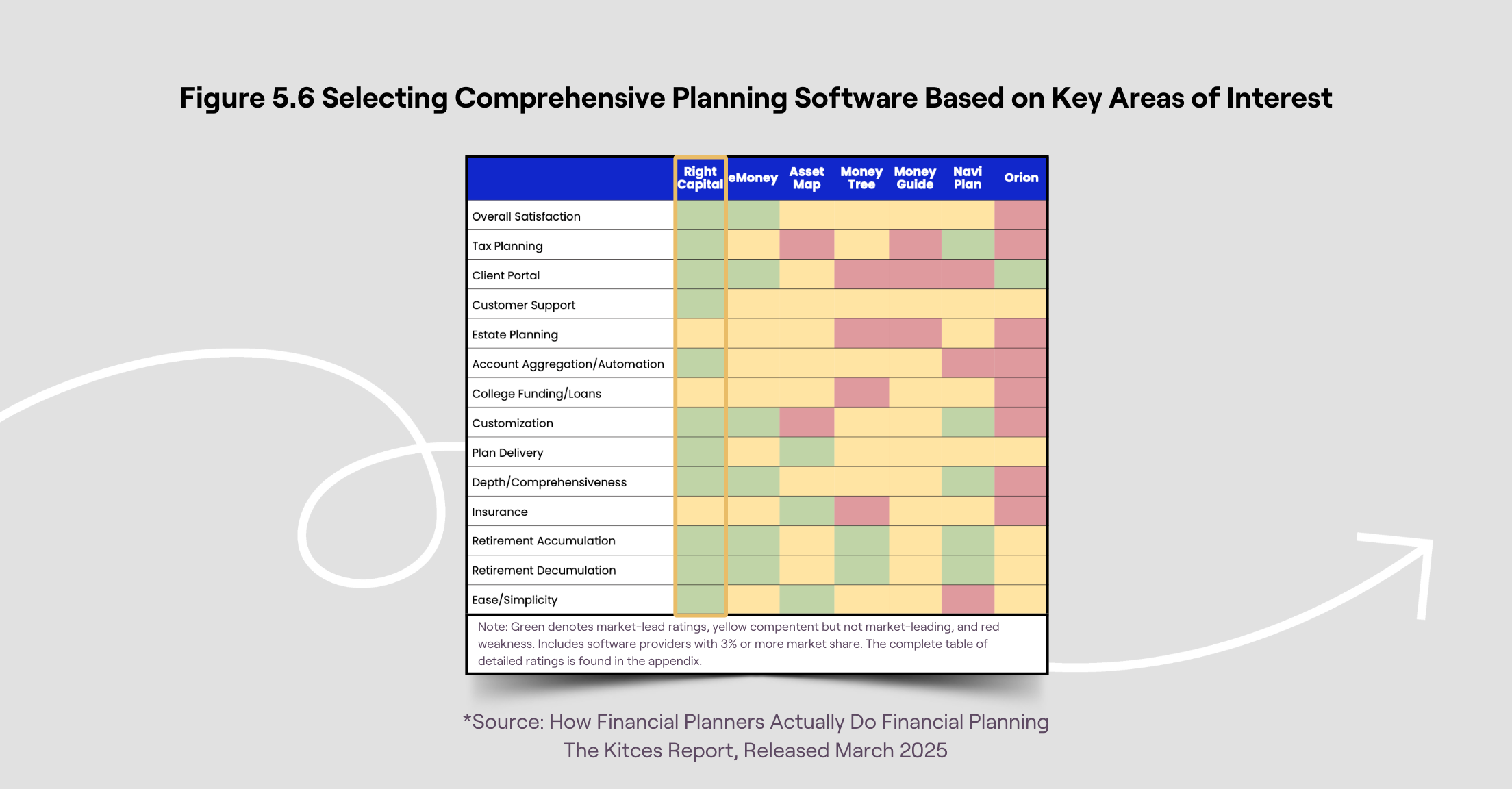
That's where RightCapital earns its place. Propose a SLAT or a GRAT and the Comparison tab puts the current plan against the proposed one—what heirs receive, what goes to charity, total taxes and fees—with a second view showing how trust income affects the client's retirement income. Values update in real time as you adjust the strategy. Advisors are able to use flow charts, trust modeling, side-by-side comparisons, and tax law scenario testing without a premium add-on. RightCapital continues to earn the highest satisfaction ratings in financial planning software in both the Kitces Advisor Technology Report and the T3 survey.
Schedule a RightCapital demo and see how estate strategies fit into a client's complete financial picture.
Estate planning software FAQs
Estate planning tools are the software advisors use to model, document, and visualize how a client's wealth transfers at death, including what passes through probate and what avoids it. They fall into three rough categories: comprehensive planning platforms that model estate outcomes inside the broader financial plan, document platforms that produce wills and trusts, and analysis tools that read or map what a client already has. Most practices use something from more than one of these categories.
It depends on whether you need to model estate plans or produce them. Planning software handles the modeling (estate tax projections, trust comparisons, flow charts) using client data you've already entered. Drafting wills and trusts generally requires a dedicated document provider. Without documents in place, a client dies intestate and state law decides who inherits.
Start with whether the estate module draws on the same client data as the rest of the plan, so you're not re-entering accounts, ownership, and assumptions that already exist elsewhere. From there, look for a client-facing flow chart, the ability to build proposed strategies and compare them against the current plan side by side, and support for the trust types you actually use—checking whether advanced ones are included or gated behind a paid add-on. It's also worth seeing how far a comparison goes: the strongest tools show not just what heirs receive under each scenario, but what the strategy costs the client in retirement income along the way.