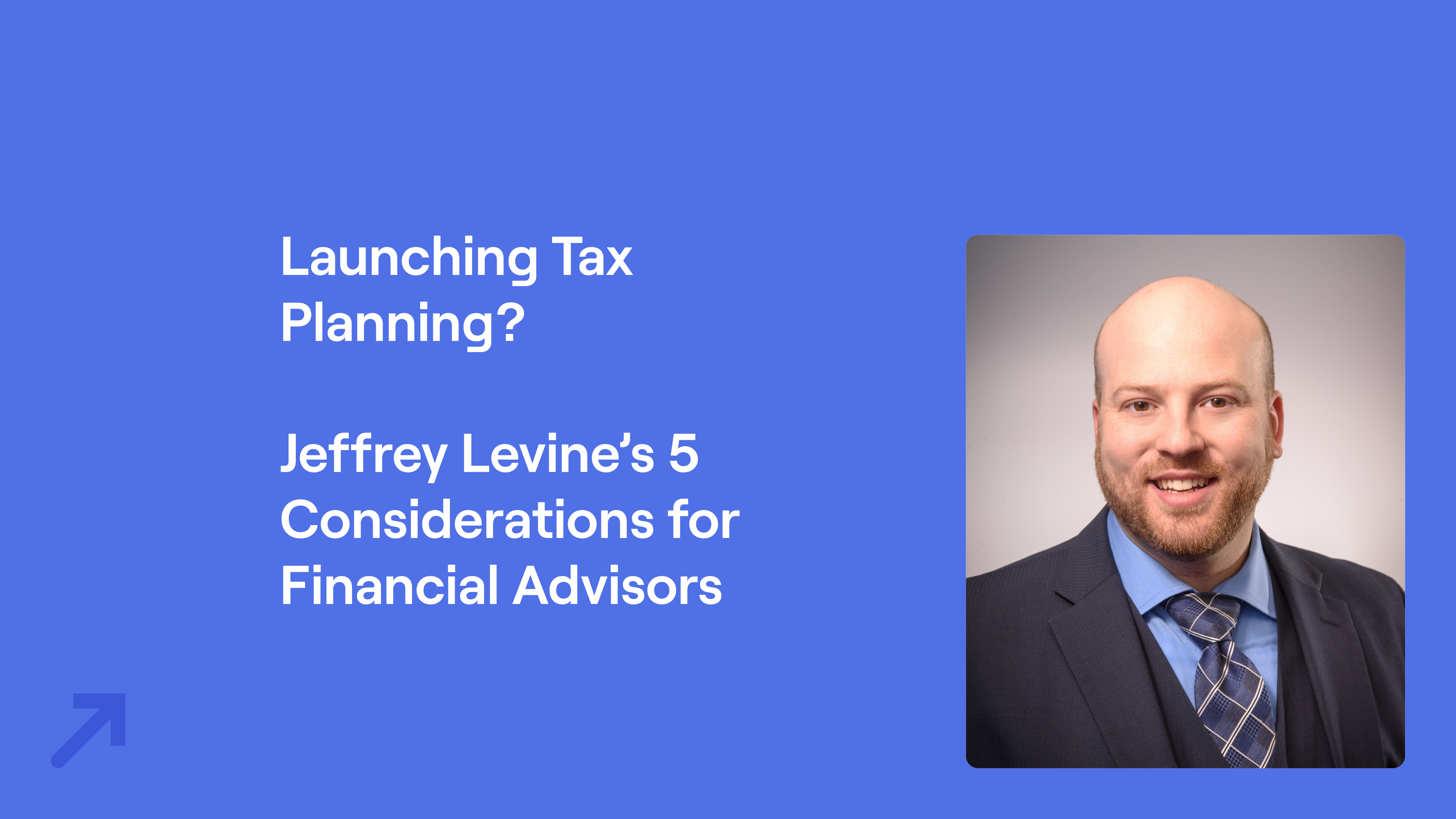
Launching Tax Planning? Jeffrey Levine’s 5 Considerations for Financial Advisors
November 6, 2026
Key Takeaways
- Before adding tax planning to your services, make sure you have the knowledge to meet your fiduciary duty and follow your firm’s policies, which may be more conservative than the law.
- Check with your errors and omissions (E&O) insurance carrier and know what you absolutely cannot do, such as representing clients before the IRS and writing tax opinion letters.
- Choose tax planning software that can both review a client's past tax returns and quickly model new scenarios, so your workflow stays repeatable and profitable.
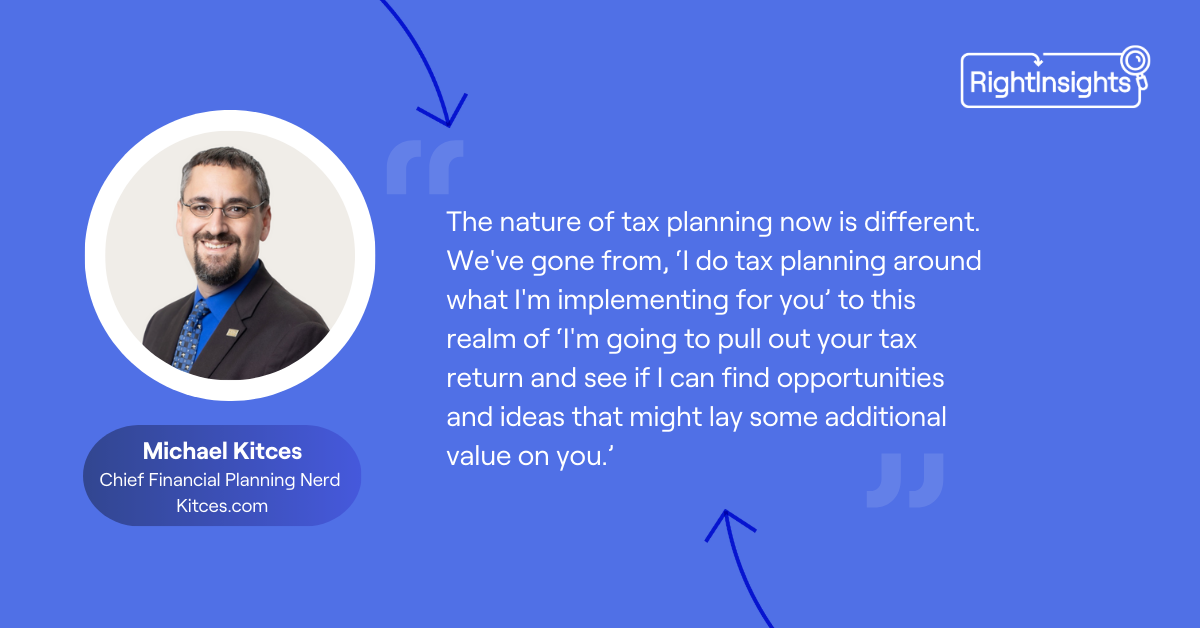
More and more clients want tax planning from their financial advisor. As Jeffrey Levine, CPA/PFS, CFP®, put it during his RightInsights webinar, "You don't have to do tax planning to be a successful financial advisor today, but it sure helps. It is sure where the industry is trending, and it's what clients want."
Levine is Lead Financial Planning Nerd at Kitces.com, Chief Planning Officer at Focus Partners Wealth, and a certified public accountant (CPA). His session, “Integrating Tax Planning Across the Financial Plan,” covered several considerations advisors should be thinking about before incorporating tax planning into their practices.
1. Make sure you have the knowledge to meet your fiduciary duty
Tax planning comes with the same responsibility as any other advice you give. "If you're acting as a fiduciary, you owe your client a duty of care that you have knowledge, and you're able to competently guide them in that area," Levine said.
For many advisors, that foundation is already there. Tax planning is part of the CFP® curriculum, and Levine noted that for some client questions, "that might be good enough." For others, you may need more, whether through continuing education programs such as RightInsights or additional tax training.
You also don't need to master everything on day one. "If you're just getting started, maybe you're not modeling the more complex stuff that's out there, and that's fine," he said. When asked where advisors should focus first, Levine pointed to a few core areas:
- Reviewing last year's tax return: Helping clients understand what already happened is "really a helpful thing," and you don't even need software to do it, though it does help.
- Roth conversions: Roth conversions are “applicable to almost everyone," Levine said, calling the strategy "the magic wand of income," since you get to decide exactly when that income is created.
- Withdrawals, capital gains, and charitable giving: Levine also pointed to structuring withdrawals across account types and deciding when to take capital gains, as well as charitable giving and bunching itemized deductions for clients with larger portfolios.
It also helps to understand how extra income ripples through a client's finances. Levine noted that a little more income can trigger a surtax or phase clients out of tax credits and deductions, all without changing their tax bracket. It can also affect how much of their Social Security is taxable.
Before you launch, take an honest inventory. Which of these tax strategies can you confidently explain and model today, and where are the gaps you'll need to fill? From there, decide which you'll offer at launch and which you'll add as your knowledge grows.
2. Know which rules apply, whether your firm's policies or the law
When your firm's policies and the law differ on what you can say about taxes, follow whichever is more conservative.
"If your firm says something more conservative, you gotta follow your firm's policies," Levine said. He also urged advisors to "always talk to your compliance departments and your teams." Before you launch, ask them to review the specific services you plan to offer, and find out whether your firm limits what you can say about taxes or how you can say it.
That conversation should also cover how tax decisions show up in your paperwork. Levine gave an example from asset location. Some advisors adjust a client's allocation to account for the taxes built into a traditional individual retirement account (IRA). That can make a portfolio look like 60/40 on paper when the client's investment policy statement (IPS) says 50/50. If you take that approach, Levine warned, "that better be baked into your IPS, and you better make sure the regulator understands it." He has heard from peers who had confusing conversations with regulators over exactly this issue.
3. Confirm your insurance coverage
Before offering tax planning, ask your errors and omissions (E&O) insurance carrier whether it's covered and whether you need an endorsement or rider. Firm policy is one layer of protection. Insurance is another, and it matters most for advisors who don't have a large firm behind them.
"If you're a solo advisor, or you're a small business here, and you're part of an entity, you want to make sure that you're properly covered," Levine said. Before you launch, let your carrier know you plan to offer tax planning. Levine suggests asking three direct questions: "What does your E&O carrier say about this? Where do they draw the line? What will they cover?"
Depending on the answers, "it might be a specific endorsement that you have to have, or a rider, to make sure that you're properly covered for this," he said. "You certainly want to make sure that you are managing your own risk as well."
4. Know the hard lines between tax planning and tax advice
Financial advisors who aren't CPAs, attorneys, or enrolled agents shouldn't represent clients before the IRS or write tax opinion letters. Outside of those limits, Levine says most tax planning and projections are fair game…legally, at least.
Many advisors hold back on tax planning because they're afraid of giving "tax advice." Levine's view is that there are not as many legal lines as most people think. "There's very few things that you can't do because they are specifically prohibited by law or regulation," he said.
Here are the hard lines he highlighted:
- Don't represent clients before the IRS: "If you want to represent your client in front of the IRS, you need to be a licensed CPA, you need to be an attorney, you need to be an enrolled agent," Levine said. An advisor shouldn't be "calling up the IRS and trying to defend your client on audit."
- Don't write tax opinion letters: Per Levine, an advisor shouldn't tell a client, "This is a very gray area of the law, but I think it's more likely than not that you'll get this tax break."
Beyond those two limits, most of what advisors want to do is allowed. Levine offered two examples: showing clients how a Roth conversion might help them, or how much more would be tax-free if they held qualified small business stock for five years instead of four.
Most advisors aren't looking to take on tax preparation or argue gray areas of the law anyway. As Levine put it, they "just want to know if there's a solution I can bring up to help my clients save taxes. Can I do that, and can I show them what it might look like in some projection tools that I have access to?"
His answer: "From a legal perspective, the answer is absolutely yes."
That's the point many advisors miss. In most cases, the thing holding them back from tax planning isn't the law. It's the fear of overstepping. Just as Levine reminded advisors throughout the session, stay within your firm's policies and E&O coverage.
Two habits make it easier to say yes with confidence:
- Frame recommendations as projections: Nearly every financial plan assumes the client dies at some age, often 95. "Is that giving the client actuarial advice? No, it's a projection." Tax planning works the same way. The key is to say "here's what we project," not "here's exactly how much you'll save."
- Bring in the client's CPA: If you're unsure, or your firm limits you, you can still educate the client. "You can always say, here's something interesting, why don't we confirm this with your CPA?" Levine said.
Build both habits into your process from the start, so every client conversation starts on solid ground.
5. Choose tax planning software that looks backward and forward
The best tax planning software for financial advisors does two things: it reviews what already happened on a client's tax return, and it quickly models what could happen next.
Levine recommends planning tools that can do historical reporting and also let you "adjust numbers, or forecast numbers, or try different things." In particular, "you want a tool that allows you to create different scenarios relatively quickly."
Levine pointed out that advisory fees have been “remarkably stable,” at least for advisors who bill on assets under management (AUM), but the cost to serve each client has gone up because clients now want more, including tax planning. In his view, margin compression is a bigger risk for most advisors today than fee compression. "Having good tech tools in your stack is one of the best ways, if not the best way right now, to help avoid that compression."
As you compare tax planning software, look to four capabilities:
- A look back: Tax returns don't list a client's effective or marginal tax rate, but "those are important things to know from a planning perspective," Levine said. In RightCapital's Tax Analyzer, for example, you can upload a client's return as a PDF. The tool automatically reads the Form 1040 and supported tax forms, such as Schedule A for itemized deductions and Schedule SE for clients with self-employment income. It redacts sensitive client data, then provides visual summaries of federal income taxes, a breakdown of ordinary income brackets (including the income applied to each tax bracket range), and more.
- A look forward: You should be able to test a change and see the result right away. In Tax Analyzer, you can create alternative scenarios and compare them against the original return, showing the difference in federal income tax, adjusted gross income (AGI), taxable income, deductions, and where each scenario falls in the tax brackets. A separate Thresholds tab shows how the change affects eligibility for income-based contributions, tax credits, deductions, and more. For longer-term strategies, Tax Strategies can model Roth conversions that fill up a chosen ordinary income bracket, capital gains bracket, or Medicare premium tier (Income-Related Monthly Adjustment Amount, or IRMAA), then compare total taxes paid and tax-adjusted ending wealth.
- A clear client presentation: Levine compares it to the eye doctor: "Number one, number two, which one's better?" When clients can see their options side by side, "a lot of times, clients end up sort of figuring out what makes the most sense on their own."
- A repeatable workflow: Software presents results in a consistent format, so "you get economies of scale presenting to clients on these issues." The real test is whether your tech stack lets you serve more clients without adding more hours.
You also don't need one tool to do everything. Levine sees general financial planning software and tax-specific tools as "complementary products," with "a time and place for both of them."
Build the foundation, then scale up
Once you've built the knowledge, cleared your services with compliance, confirmed your coverage, learned the hard lines, and chosen the right tax planning software, the work gets easier with every client.
As Levine emphasized, tax planning doesn't have to be exact to be valuable. "It's still about assumptions, but it's, can we go in a directionally positive way for the client?"
See how RightCapital supports tax planning
Tax Strategies is available across RightCapital plans. Tax Analyzer is included with Premium and Platinum subscriptions. For a closer look at both, read Tax Planning in RightCapital: Tax Strategies and Tax Analyzer, or schedule a personalized 1:1 demo.
Want to hear more from Jeffrey Levine? Watch the full RightInsights' session recording.
Frequently asked questions
Based on Jeffrey Levine's RightInsights session, advisors should confirm they have the knowledge to meet their fiduciary duty, check what their firm allows, confirm coverage with their errors and omissions (E&O) insurance carrier, understand the few legal limits on tax advice, and choose technology that can review past tax returns and model future scenarios.
Kitces.com's Jeffrey Levine suggests starting with the basics, and you don't need to model complex strategies on day one. Good first steps are going over a client's prior-year tax return with them, modeling Roth conversions, structuring withdrawals across account types, and timing capital gains. Charitable giving and bunching itemized deductions are also worth covering for clients with larger portfolios. From there, advisors can add more advanced strategies as their knowledge and tools grow.
Jeffrey Levine, of Kitces.com, recommends tax planning software that can do historical reporting, such as reviewing a client's prior-year tax return, and also model different scenarios quickly. Clear client-facing visuals and a repeatable workflow help advisors deliver tax planning efficiently. General financial planning software and tax-specific tools can work together.