Student Loan Repayment: How Advisors Can Help Clients Navigate RAP, SAVE, and What Comes Next
October 30, 2026
Key Takeaways
- The repayment plans a client can use depend on whether they have taken out or consolidated a federal loan since July 1, 2026.
- The new Repayment Assistance Plan (RAP) bases payments on total income and dependents. Borrowers who pay in full and on time will not see balances grow.
- Borrowers leaving Saving on a Valuable Education (SAVE) have a personal deadline on their servicer notice. Missing it may land them in a plan with a much higher payment.
- Pay As You Earn (PAYE) and Income-Contingent Repayment (ICR) end on July 1, 2028. Clients using those payment plans have a decision coming.
- Refinancing federal loans with a private lender permanently gives up federal repayment plans and forgiveness.
- The lowest monthly payment isn't always the right answer.
According to Federal Student Aid, as of June 2026, about 42.3 million people have federal student loans, together totaling more than $1.7 trillion. Yet, per the Kitces Report released in March 2025, just 31% of advisor respondents were including student loans in a financial plan. If you have clients with student loans, there's a good chance one of them has shown you a letter from their loan servicer and asked, "What do I do with this?"
The One Big Beautiful Bill Act (OBBBA), signed into law in July 2025, brought a major round of changes to federal student loan repayment. It created a new income-driven plan, closed off Saving on a Valuable Education (SAVE), put an end date on Pay As You Earn (PAYE) and Income-Contingent Repayment (ICR), and split borrowers into two groups with different options.
All that change creates confusion and, for advisors, an opportunity to strengthen client relationships and confidence in their financial plan. Student loans touch cash flow, taxes, retirement savings, and nearly every other goal in a plan. Helping a client make a smart repayment decision is one of the most concrete ways to show the value of financial planning.
Here's what changed, what to look for first, and how to turn a confusing letter into a confident decision.
Which rules apply to your client?
Under the new rules, two clients with the same balance can have completely different options. Which options a client has comes down to two things: what kind of loans they have and when they borrowed.
Loan type
Student loans fall into two broad groups. Federal loans are funded by the U.S. government; most are Direct Loans issued by the U.S. Department of Education. Private loans come from banks, credit unions, and other lenders, which set their own terms.
Loan type matters because it decides which repayment plans and forgiveness programs a client can use. Here's a quick guide:
Loan Type | Definition | What it means for repayment |
|---|---|---|
Direct Subsidized | Federal loans for undergraduates with financial need. The government pays the interest while the student is in school at least half-time and during grace and deferment periods. | Eligible for income-driven plans and PSLF (Public Service Loan Forgiveness) |
Direct Unsubsidized | Federal loans for undergraduate, graduate, and professional students, not based on need. Interest builds from the start. | Eligible for income-driven plans and PSLF |
Grad PLUS | Federal loans for graduate and professional students that require a credit check. Generally no longer available to new borrowers as of July 1, 2026. | Eligible for income-driven plans and PSLF |
Parent PLUS | Federal loans parents take out for a dependent undergraduate student | Not eligible for RAP and needs its own analysis (more below) |
Direct Consolidation | Combines existing federal loans into one new Direct Loan | Generally eligible for RAP unless it paid off Parent PLUS debt. Consolidating now would move the borrower into the new rules. |
FFEL and Perkins | Older federal loans made by private lenders (FFEL, ended in 2010) or by schools (Perkins, ended in 2017) | Usually need to be consolidated into a Direct Consolidation Loan to qualify for PSLF and most income-driven plans |
Private | Loans from banks, credit unions, and other lenders, usually based on credit | No federal repayment plans or forgiveness. |
Borrowing date
For federal borrowers, the next question is timing. The OBBBA effectively split borrowers into two groups:
- Legacy borrowers have loans disbursed before July 1, 2026 and haven't taken out a new federal loan or consolidated since. They keep access to Income-Based Repayment (IBR), along with PAYE and Income-Contingent Repayment (ICR) until 2028, and the new Repayment Assistance Plan (RAP) if their loans qualify.
- Borrowers under the new rules have taken out a new federal loan or consolidated on or after July 1, 2026. For their Direct Loans, the choices generally narrow to RAP or the new Tiered Standard Plan.
That second group is worth noting. A single new loan, such as one taken out for another degree, can generally move a client's whole Direct Loan portfolio into the new rules. If a client is thinking about borrowing again or consolidating, that's a conversation to have before they sign anything.
How the Repayment Assistance Plan (RAP) works
RAP is a new income-driven repayment plan, and it works differently from the plans clients may be used to. The math is fairly simple. Take the borrower's adjusted gross income (AGI) and apply a percentage that ranges from 1% to 10%, rising one point for each $10,000 of income. (AGI of $10,000 or less gets a flat $120 a year.) Divide by 12, then subtract $50 a month for each dependent. The minimum is $10 a month.
Adjusted gross income | Annual base payment |
|---|---|
$10,000 or less | $120 |
$10,001 to $20,000 | 1% of AGI |
$20,001 to $30,000 | 2% of AGI |
$30,001 to $40,000 | 3% of AGI |
$40,001 to $50,000 | 4% of AGI |
$50,001 to $60,000 | 5% of AGI |
$60,001 to $70,000 | 6% of AGI |
$70,001 to $80,000 | 7% of AGI |
$80,001 to $90,000 | 8% of AGI |
$90,001 to $100,000 | 9% of AGI |
$100,001+ | 10% of AGI |
For example, a borrower with $35,000 of AGI and no dependents would pay 3% of $35,000, or $1,050 a year. That works out to $87.50 a month. For married borrowers, RAP uses joint income if the couple files jointly and individual income if they file separately.
How RAP compares to Income-Based Repayment (IBR)
RAP is the only income-driven plan for borrowers who borrowed or consolidated on or after July 1, 2026. Legacy borrowers can also choose Income-Based Repayment (IBR) but after PAYE and ICR end in 2028, RAP and IBR will be their only two income-driven options.
IBR sets payments at 10% or 15% of discretionary income (AGI minus 150% of the federal poverty guideline), depending on if the client first borrowed after or before July 1, 2014 respectively. Payments are capped at the 10-year Standard payment, the fixed amount that would pay off the loan in 10 years. RAP applies its percentage to total AGI and has no cap.
RAP’s built-in protections
RAP also comes with two protections for borrowers who make their full payments on time:
- Unpaid interest waiver: If the payment doesn't cover all of the month's interest, the remaining interest is waived. The unpaid interest does not increase the borrower’s balance.
- Principal payment match: If an on-time payment reduces principal by less than $50, the government makes a matching payment so principal drops by $50 that month (or by the amount of the payment, if it's under $50).
That can be a real benefit for lower-income borrowers. On the other hand, there's no payment cap, so payments can keep rising as income grows and can eventually exceed the 10-year Standard payment. Repayment can stretch up to 360 payments or 30 years. Under current federal law, any balance forgiven at the end is considered ordinary income from a tax perspective.
RAP works for Direct Subsidized, Direct Unsubsidized, graduate PLUS, and Direct Consolidation Loans. Parent PLUS loans and consolidation loans that paid off Parent PLUS debt are not eligible for RAP.
What's happening to SAVE, PAYE, ICR, IBR, and Parent PLUS loans?
SAVE is no longer an option. Borrowers in SAVE forbearance have to choose a new plan and servicers are sending transition notices in waves. Each borrower gets at least 90 days from their own notice to decide, so there's no single national deadline. If a client doesn't choose in time, they may be placed in the Standard or Tiered Standard Plan, which can mean a big jump from a low SAVE payment. If you have clients who were on SAVE, it's worth confirming they've received their notice and know their date.
PAYE and ICR both end on July 1, 2028 and remain only for qualifying legacy loans and borrowers. Clients in either plan will need to choose another option by July 1, 2028. Clients who don't choose may be moved automatically into RAP if their loans qualify, or in some cases, such as certain Parent PLUS consolidation loans, into IBR.
IBR is still available for eligible borrowers with legacy loans.
- Original IBR (for borrowers with federal loans prior to July 1, 2014) generally uses 15% of discretionary income for up to 25 years.
- Newer IBR (for borrowers with no outstanding federal loan balance when they borrowed on or after July 1, 2014) uses 10% over up to 20 years.
Both cap payments at the 10-year standard amount, a protection RAP doesn't have.
Depending on the client's income and family size, either RAP or IBR could have the lower payment, so legacy borrowers should compare both before choosing. The OBBBA also removed IBR's partial financial hardship requirement. Before, borrowers whose income was too high compared with their loan balance couldn't enroll in IBR. That was one reason SAVE, which never had this requirement, appealed to so many borrowers. Now legacy borrowers leaving SAVE can choose IBR regardless of income.
Parent PLUS loans are different. Some Parent PLUS Direct Consolidation loans completed before the new rules took effect can use ICR through June 2028 and may move to IBR after that if the borrower is enrolled in an income-driven plan in time.
The new Tiered Standard Plan
For borrowers under the new rules, the Tiered Standard Plan replaces the 10-year Standard plan as the fixed-payment option. Instead of a flat 10 years, the repayment term depends on how much the client owes:
Total Direct Loan balance | Repayment term |
|---|---|
Less than $25,000 | 10 years |
$25,000 to $49,999 | 15 years |
$50,000 to $99,999 | 20 years |
$100,000+ | 25 years |
Similar to the Standard plan, payments don't change with income or family size, and the loan is paid off in full by the end of the term, with no forgiveness offered. While a longer term typically lowers the monthly payment compared to the Standard plan, it can increase the total interest paid. Unlike the Standard plan, the Tiered Standard payments don't count toward PSLF, which matters a lot for clients working in the public sector.
Where Public Service Loan Forgiveness (PSLF) fits in
For clients who work for a government agency or a qualifying nonprofit, PSLF can change the entire analysis. It forgives the remaining balance on Direct Loans after 120 qualifying payments made while working full-time for an eligible employer. That forgiveness is still federally tax-free.
PSLF itself is intact at the moment. RAP, IBR, ICR, PAYE, and the 10-year Standard plan all count as qualifying plans. Tiered Standard doesn't, so clients pursuing PSLF generally need to stay in an income-driven plan. Eligibility depends on who the client works for, not their job title, and clients should certify their employment every year and whenever they change jobs.
Consolidating can reduce a PSLF client's qualifying payment count, since the new loan gets a weighted average of the original loans' payments.
Is refinancing still worth considering?
Refinancing replaces existing loans with a new private loan, ideally at a lower rate. It's different from federal consolidation, which keeps loans in the federal system.
For private loans, refinancing can be a smart move, especially if a client's credit or income has improved since they first borrowed. For federal loans, it's a much bigger decision. Refinancing with a private lender permanently gives up income-driven repayment, PSLF and other forgiveness opportunities, and federal deferment and forbearance, and it can't be undone. It may make sense for a high earner with a stable job and no plans to use those benefits, but it's rarely the right call for someone relying on an income-driven plan or PSLF.
Repayment options side by side
Feature | RAP | Tiered Standard | IBR | PAYE/ICR | ICR |
|---|---|---|---|---|---|
Payment basis | Total AGI and dependents | Loan balance | 10% or 15% of discretionary income | 10% of discretionary income | The lower of 20% of discretionary income or an income-adjusted 12-year fixed payment |
Repayment period | Up to 30 years | 10 to 25 years | 20 or 25 years | 20 years; | 25 years |
Payment cap | None | Fixed payment | 10-year Standard amount | 10-year Standard amount | None |
Unpaid interest protection | Unpaid interest waived with full, on-time payments | None | Unpaid interest on subsidized loans covered for first three years | Unpaid interest on subsidized loans covered for first three years | None |
Principal assistance | Up to $50 a month | None | None | None | None |
Partial financial hardship required? | No | No | No (removed in 2025) | Yes | No |
Time-based forgiveness | After 360 qualifying payments | No | After 20 or 25 years | After 20 years | After 25 years |
Counts toward PSLF | Yes | No | Yes | Yes | Yes |
Availability | Ongoing | Ongoing | Qualifying legacy loans only | Ends after June 30, 2028 | Ends after June 30, 2028 |
Eligibility must be established before comparing projected outcomes
A real-world example: one household, two sets of rules
Jim and Pam are married with a 3-year-old. They file taxes separately, and Jim claims their child as a dependent. Right now, they're juggling childcare costs, trying to rebuild their emergency fund, and want to keep contributing to retirement.
Jim, 35, is a public school counselor earning $72,000. He has $50,000 in legacy Direct Loans and has made 72 of the 120 payments he needs for PSLF. Pam, 34, is a physical therapist at a private clinic earning $64,000. She has $90,000 in Direct Loans, and while most are legacy loans, she took out an $18,000 loan in August 2026.
That one loan changes things. Jim keeps his legacy options, so IBR is still on the table. Pam’s new loan generally moves her Direct Loans into the new rules, so her choices are RAP or Tiered Standard.
On RAP, Jim’s payment would be 7% of $72,000, divided by 12, minus $50 for their child, or about $370 a month. Pam’s would be 6% of $64,000, divided by 12, or about $320 a month. That's about $690 a month for the household. A fixed-payment approach would cost much more up front, about $1,050 a month in this example, but would pay the loans off on a set schedule instead of heading toward forgiveness.
So which is better? It depends on questions only a real plan can answer:
- Will Jim stay in public service for his remaining 48 PSLF payments?
- Could raises push either of them into a higher RAP income band?
- Does filing separately save more on student loans than it costs in taxes?
- If a lower payment frees up cash, should it go toward their emergency fund, retirement, or childcare, and is that worth staying in repayment longer?
- Could future time-based forgiveness create a tax obligation?
No single option checks every box. The real value is making the trade-offs clear so Jim and Pam can make a decision that fits their whole financial picture.
A time-sensitive reason to talk to clients now
Federal borrowers who enroll in autopay by 11:59 p.m. ET on December 31, 2026, get a 1% interest rate reduction through June 30, 2028, up from the usual 0.25%. It applies to Direct Loans disbursed on or after July 1, 2012, including Parent PLUS loans. Clients already on autopay get this reduction automatically. It stops if the client cancels autopay or moves into deferment or forbearance. Checking a client's autopay status is a quick, easy way to start a student loan conversation before year-end.
How to start the student loan conversation with clients
Gather the loan details. Have the client log in to studentaid.gov and their servicer's portal to collect the following information from both sites:
- Each loan's type, balance, and interest rate
- The current repayment plan, how many payments were made on that plan, and when any income-driven plan was started
- How many payments have counted toward forgiveness or PSLF
- Any consolidation history
- Any recent notices, especially SAVE transition letters
- Whether autopay is turned on
- Sort each loan by type. Separate federal loans from private loans, then note which federal loans are Direct, Parent PLUS, older FFEL or Perkins loans
- Confirm which repayment options are available. Use the loan details to see which plans each loan qualifies for, including whether any new loan or consolidation since July 1, 2026 has moved the client into the new rules.
- Find any deadline that applies, whether it's a SAVE notice date or the 2028 PAYE and ICR end date.
- Compare the remaining options using the same assumptions about income, tax filing status, and career path.
- Write down your assumptions and revisit the analysis when the client's life changes.
Along the way, ask clients what matters most to them. Some want the lowest payment right now. Others want to be debt-free as fast as possible, and others are focused on working toward forgiveness. Knowing their priorities makes the right answer much easier to find.
Those priorities can shift once clients see the numbers, though. A lower monthly payment can look like the obvious choice until the projections show how much more it could cost in total interest and payments over a longer repayment period. Walking through the pros and cons of each path helps clients make a decision they'll feel good about years from now, not just next month.
How RightCapital makes student loan planning easier
Student loan decisions are easier to make when clients can see how each option affects the rest of their plan. That's what RightCapital's Student Loan module is built for, and it's been updated for the changes brought on by the OBBBA.
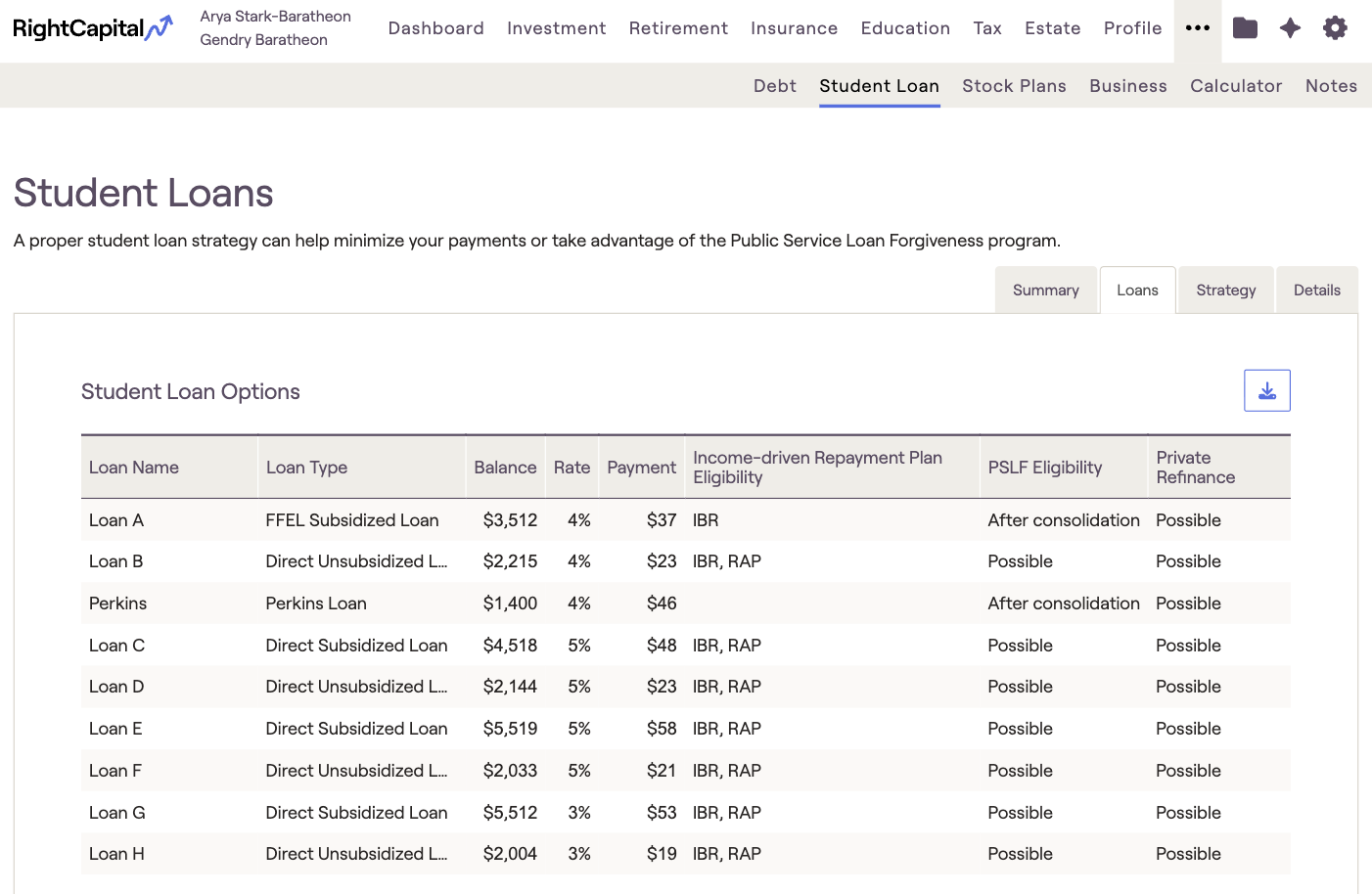
- Know every loan's options at a glance. See which income-driven plans each loan qualifies for and whether it's eligible for PSLF, based on its loan type and the client's borrower status. No more cross-referencing rules by hand.
- Test strategies in minutes. Propose the Standard plan, IBR, RAP, or a refinance with your own rate and term, model consolidation, and show what a career in public service could mean for PSLF.
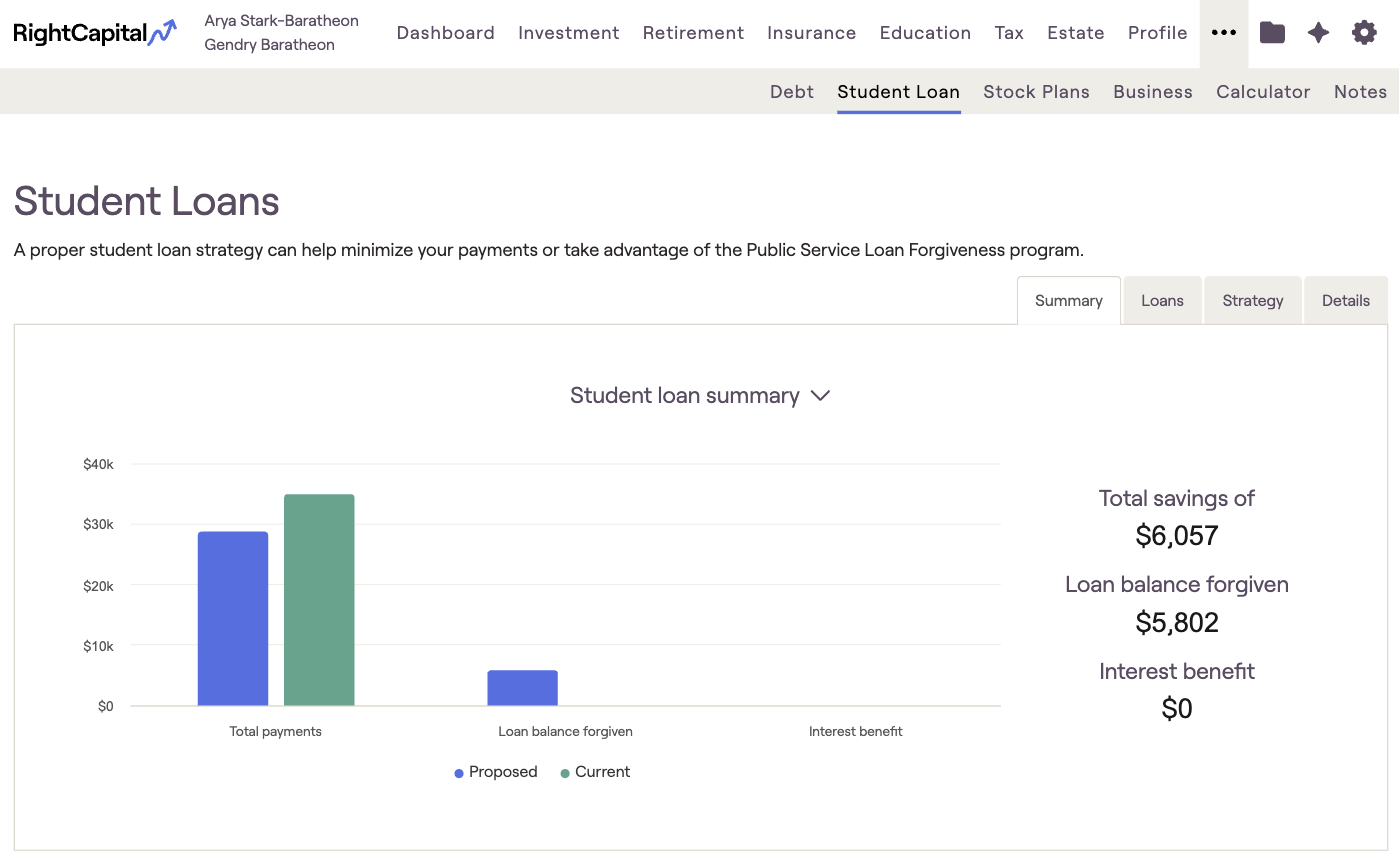
- Make the trade-offs easy to see. The Summary tab compares current and proposed strategies by total payments, forgiveness, and interest benefit, so clients can see what a lower monthly payment really costs over time.
- Walk clients through the path. The Strategy tab's flowchart shows the route toward faster payoff or forgiveness in a way clients can follow.
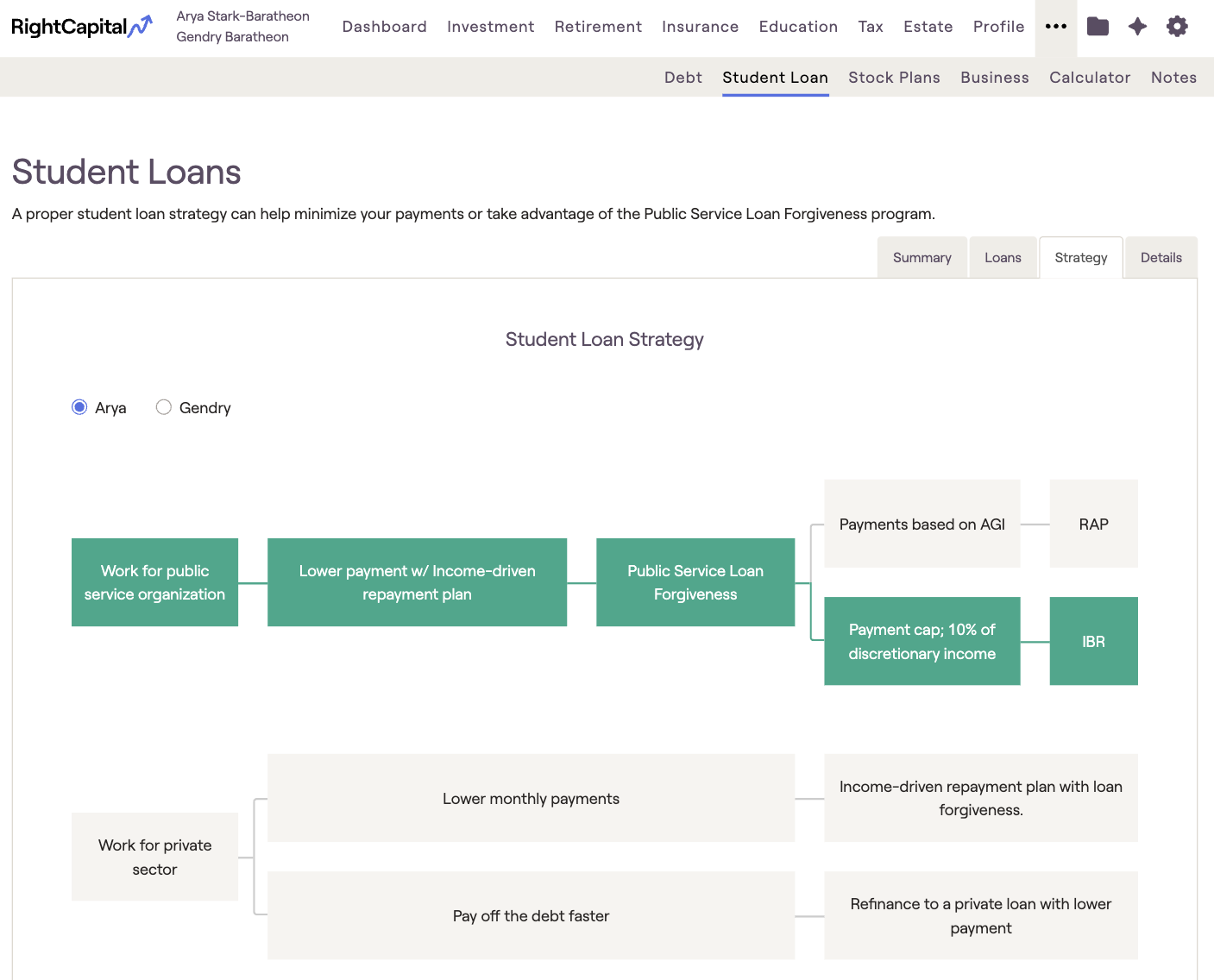
Ready to make student loan planning simpler for your clients? Schedule a demo to see RightCapital's Student Loan module in action.
Frequently asked questions
RAP is a federal income-driven repayment plan created by the One Big Beautiful Bill Act. Payments are 1% to 10% of total AGI divided by 12, minus $50 a month per dependent, with a $10 monthly minimum. Any remaining balance may be forgiven after 360 qualifying payments.
RAP applies its percentage to total AGI and has no payment cap. IBR counts only income above 150% of the federal poverty guideline and caps payments at the 10-year standard amount. IBR is only available to legacy borrowers.
Yes. RAP, IBR, ICR, PAYE, and the 10-year Standard plan all count toward PSLF. Payments under the Tiered Standard Plan don't.
Under current federal law, income-driven forgiveness processed in 2026 or later is considered ordinary income from a tax perspective. PSLF forgiveness is still federally tax-free.