RightCapital vs. Income Lab: Features, Pricing, and Fit for Advisors
October 26, 2026
Key Takeaways
- RightCapital is a comprehensive financial planning platform that covers every client life stage, while Income Lab is a specialized tool for retirement income distribution.
- In the March 2025 Kitces Report, the two platforms tied for the highest overall satisfaction in the financial planning category at 8.7 out of 10, with RightCapital holding 26% market share to Income Lab's 9%.
- Both platforms offer guardrails to adjust retirement spending as conditions change, but they differ in what triggers a spending change and who sets the rules.
- Nine in ten Income Lab users continue to use it alongside another third-party application, which the Kitces Report says indicates it primarily supplements comprehensive tools rather than replacing them.
- Income Lab may be a good single tool for a practice focused only on decumulation, but if your clients span life stages or need more options for spending strategies, RightCapital can serve as your primary platform.
Financial advisor technology is always evolving, and it can be difficult to decide which categories of software you really need. RightCapital, a comprehensive financial planning software with robust retirement planning features, and Income Lab, a specialized tool for retirement income planning, are increasingly compared. While both platforms cover retirement planning, they’re built on two different philosophies that address similar questions in different ways.
RightCapital covers every client life stage, including accumulation, decumulation, tax, estate, education, and insurance planning. Income Lab began as a retirement income distribution tool and has expanded around that retiree focus. While Income Lab is a good specialized retirement distribution tool, it does not cover the full breadth of services that RightCapital does.
In this post, we will explain the methodology difference plainly and compare the platforms’ features to help you make a decision, whether you choose one or both.
Industry ratings
If you've been comparing RightCapital and Income Lab, you've probably noticed that both platforms are talked about as advisor favorites. The independent research backs that up for both. In the Kitces Report “How Financial Planners Actually Do Financial Planning,” released in March 2025, RightCapital and Income Lab tied for the highest overall satisfaction rating in the financial planning category, at 8.7 out of 10. In that study, RightCapital had a market share of 26% and Income Lab a market share of 9%.
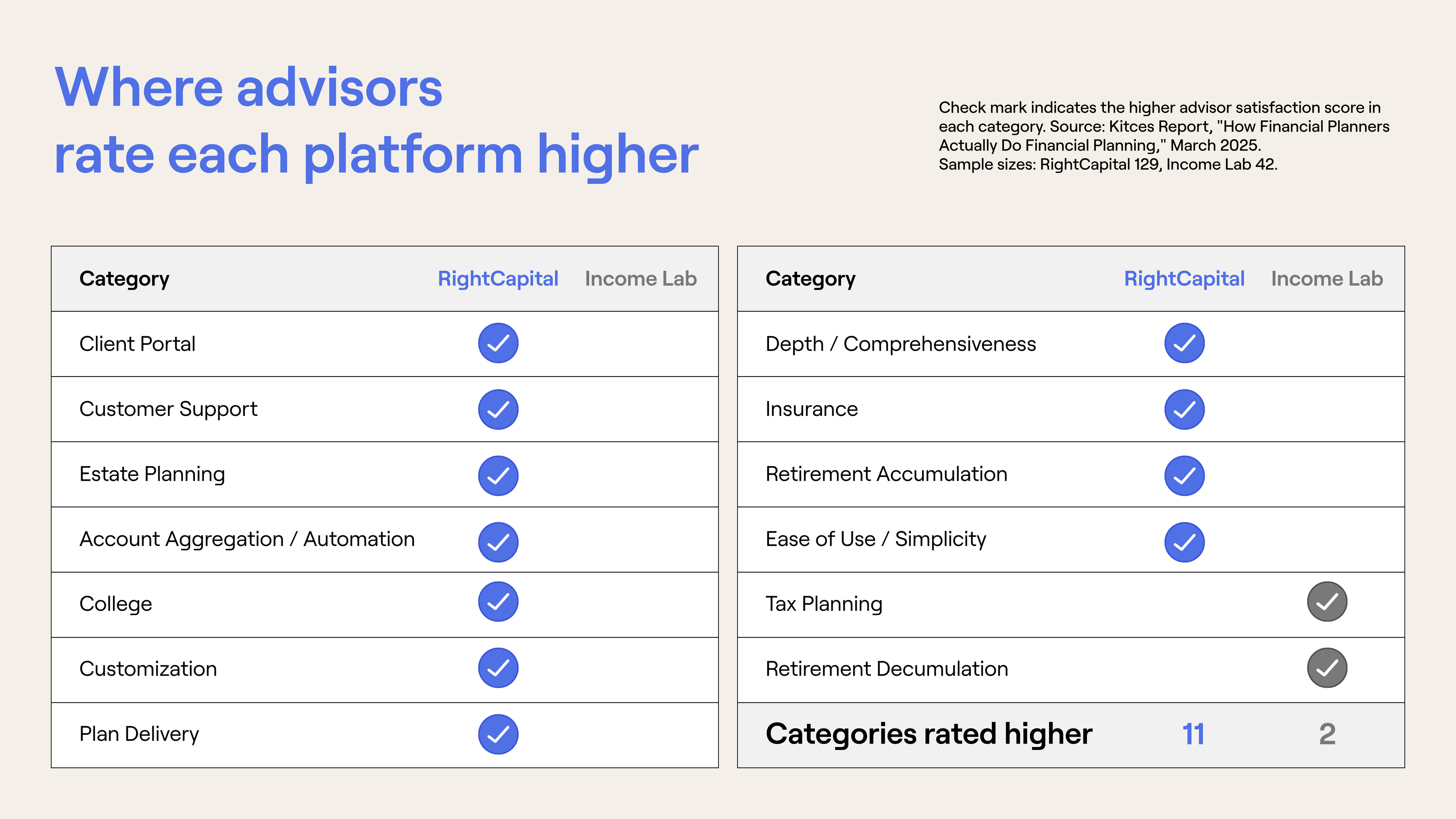
According to Kitces, nine in ten Income Lab users continue to use it alongside another third-party application, which the report says indicates it "primarily serves to supplement traditional comprehensive tools rather than replace them." The same report notes that Income Lab's growing feature set is leading more advisors to consider it a comprehensive tool in its own right. Many advisors build the full plan in a comprehensive platform and add Income Lab for clients nearing or in retirement.
The comparison below walks through where each tool fits and why the answer often depends less on which is better and more on whether you need a retirement income specialist or a platform that covers the whole plan.
The core difference: How each platform's guardrails work
Guardrails are a dynamic retirement spending strategy. Instead of withdrawing the same inflation-adjusted amount every year, the plan sets upper and lower limits, and retirement spending goes up or down when the plan crosses one of them. Both Income Lab and RightCapital offer guardrails, but they differ in what triggers an adjustment and who sets the rules.
Income Lab's risk-based guardrails
Income Lab's risk-based guardrails produce a specific monthly withdrawal amount: how much the client can take from their portfolio right now. An advisor can tell a client, "You can withdraw this much from your accounts this month, and here's what would move that number up or down."
The triggers are based on probability of success calculations. Writing on Kitces.com, Income Lab’s co-founder, Justin Fitzpatrick, and head of innovation, Derek Tharp, describe the methodology as relying on "a financial plan's probability of success, as determined through Monte Carlo simulations." In their example, the withdrawal amount starts at a level with an 80% probability of success, adjusts upward if that reaches 100%, and adjusts downward if it falls to 25%. Income Lab recalculates the guardrails monthly and sends alerts across the book, so advisors know which clients need attention before a review meeting. Its central metaphor is a GPS: you don't fail when you miss a turn; the system recalculates.
That's different from RightCapital, where guardrails adjust the client's retirement spending within the plan projection, showing how spending would rise or fall in future years as the withdrawal rate crosses the advisor's thresholds.
RightCapital's guardrails, one of several spending strategies
- Starting point: Use the plan's calculated initial withdrawal rate, or override it with your own, such as 4%.
- Upper guardrail (Capital Preservation rule): Set how far above the starting rate the withdrawal rate can rise before spending is cut, and how much to cut it.
- Lower guardrail (Prosperity rule): Set how far below the starting rate the withdrawal rate can fall before spending increases, and how much to raise it.
- Age limits: Each guardrail can stop at a different age. For example, the upper guardrail could apply until 80 and the lower until 85, so spending doesn't swing late in life.
- Inflation skip: Optionally hold spending flat the year after a zero or negative return.
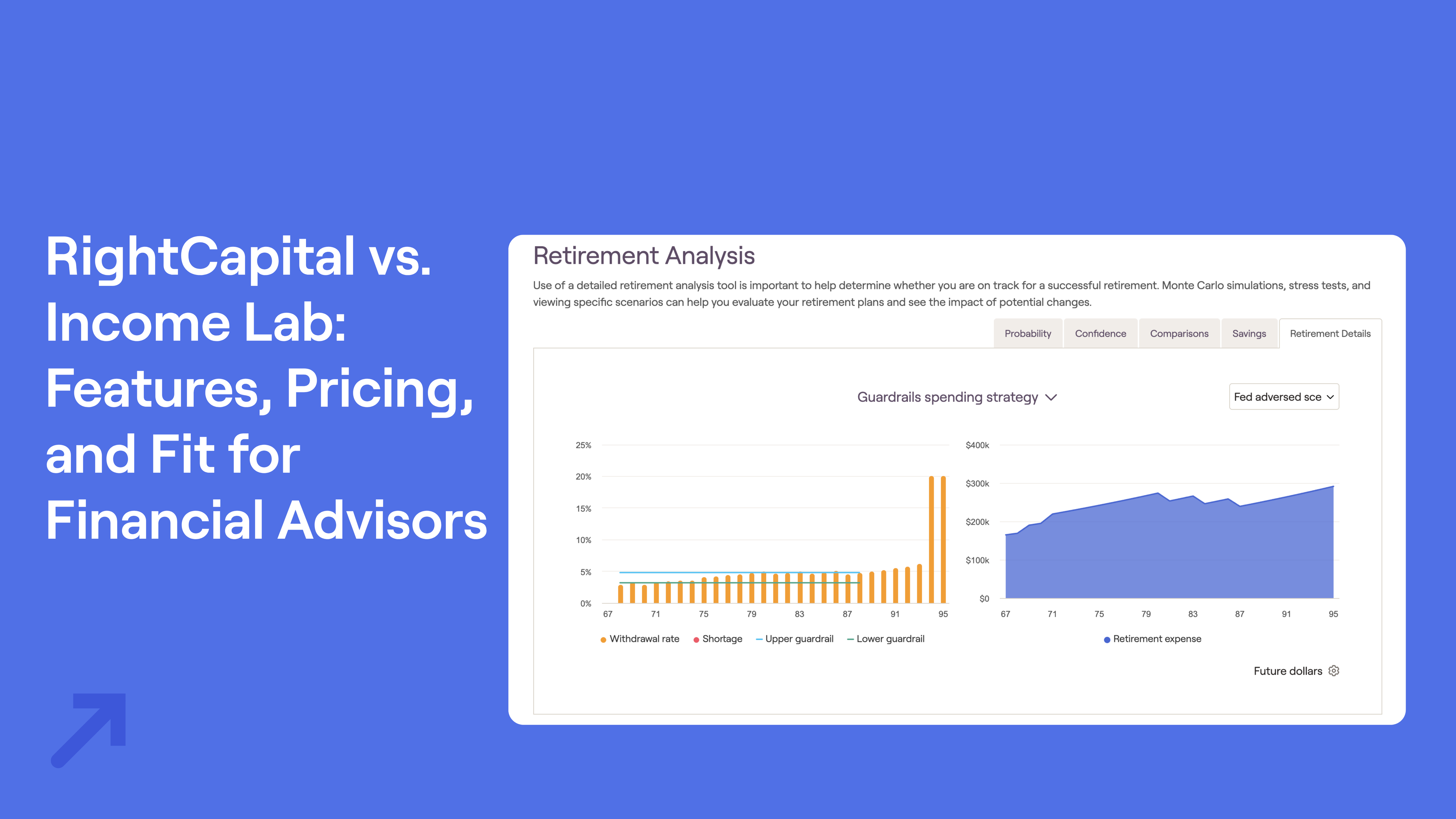
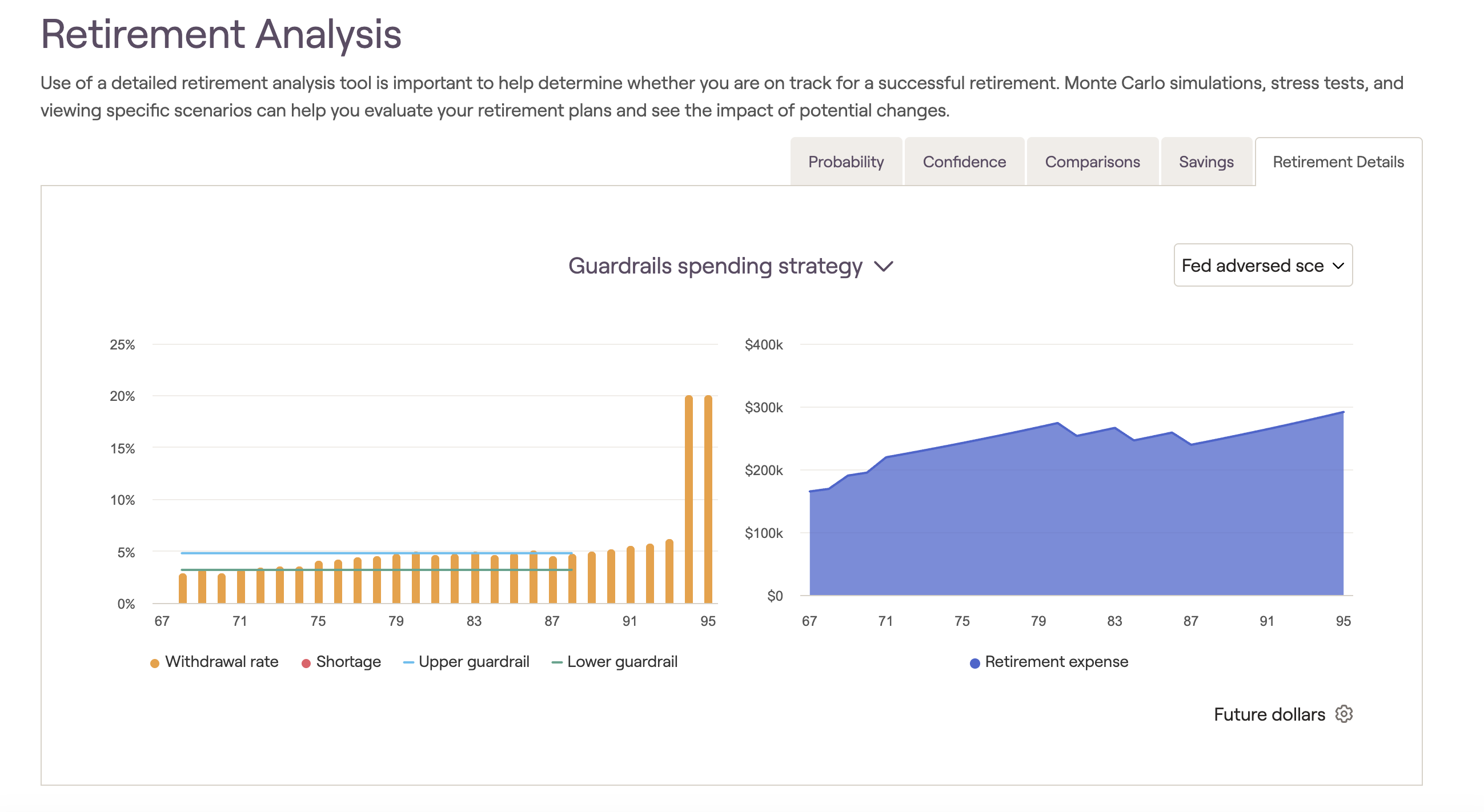
Advisors can save multiple versions of the strategy, set one as the default for new clients, adjust it for an individual client, or propose a different version as an action item to compare against the current plan. A dedicated guardrails spending strategy chart shows the withdrawal rate, both guardrails, and the resulting spending side by side, so clients can see when and why spending changed.
Guardrails is one of several built-in retirement spending strategies in RightCapital, along with inflation-adjusted, retirement spending smile, spending stages, and floor and ceiling.
How the two approaches compare
Income Lab argues that a withdrawal-rate trigger is too narrow. Its risk-based guardrails weigh more inputs, including inflation and spending, and Income Lab positions the result as a more holistic calculation. That's a fair description of the design difference, and it's a big part of Income Lab's appeal to retirement-focused advisors.
The trade-off is what drives the change. In Income Lab, adjustments follow the model's probability-of-success calculation. In RightCapital, the advisor sets the withdrawal-rate thresholds, the size of each adjustment, and the ages when the rules apply, and can tailor them client by client.
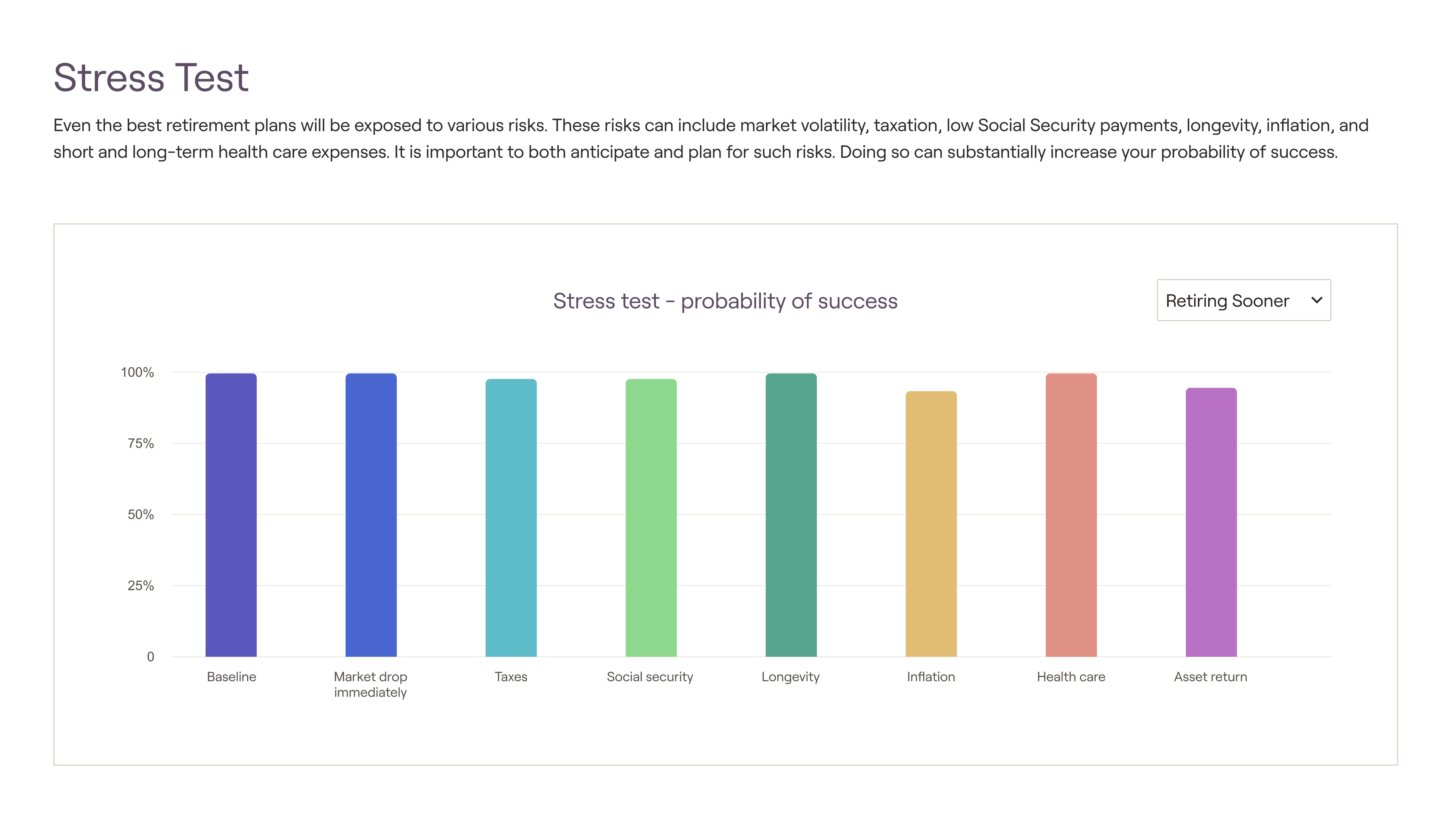
Because a client's withdrawal rate rises and falls with the market, RightCapital also lets advisors see how the guardrails would play out under different return sequences. Advisors can switch the projections to scenarios such as a bad decade followed by slow growth, a flat 0% return, or a strong growth period, or build their own, such as a market drop in year one versus year ten. The withdrawal rate, retirement spending, and cash flow projections update to show when each guardrail would trigger and how spending would change, so clients can see what a rough stretch in the market would actually mean for their spending.
How often each platform checks the plan matters too. Income Lab's monthly monitoring suits advisors who manage distributions monthly. Advisors who review spending at annual meetings, and clients who prefer a steady amount, may not need a number that's re-evaluated every month.
How each platform measures plan health
Guardrails answer how much a client can spend from their portfolio. Advisors also need to know how well the whole plan holds up, and the platforms approach that differently.
RightCapital gives advisors two independent gauges of financial well-being:
- Monte Carlo simulations: 1,000 trials of market volatility producing a probability of success, often used as a high-level view of a current or proposed plan.
- Cash flow projections: The baseline is a straight-line projection you can overlay with specific return sequences, including adverse scenarios such as a bad decade or a flat 0% market, to see how a plan holds up under a particular sequence of returns. Often used for deeper analysis and insights.
Every retirement spending strategy (including guardrails) runs on top of both, so an advisor can watch the same guardrails strategy behave under Monte Carlo and under a specific return sequence. The year-by-year projections show surplus and shortfall, including the effect of Social Security, pensions, RMDs, and IRA withdrawals.
A probability of success can be misread as a pass/fail grade. An 82% probability of success does not mean an 82% chance the plan "works." It means that across 1,000 simulated market paths, the client did not run out of money in 820 of them, based on today's inputs.
Life changes for clients, and their plans should change with them. What it takes to reach an 82% probability of success today may be different for the same client five years from now.
Iris, RightCapital's AI financial planning agent (Premium+), can then work backward from a target probability of success, returning three plan options based on levers such as retirement age, spending, savings, Roth conversions, and Social Security timing.
Both platforms run Monte Carlo simulations; Income Lab's guardrails are built on it. The difference is what gets shown to the client and what triggers an adjustment.
RightCapital runs all of this inside one plan that also handles accumulation, tax, estate, education, insurance planning, and more.
Feature comparison
Retirement income and tax planning depth
Income Lab's Tax Lab is a genuine area of specialization. It handles multi-year Roth conversion comparisons with IRMAA interaction and Social Security taxation modeling, and it produces specific dollar-and-account recommendations. Their Withdrawal Optimizer (Pro) shows which accounts should fund a year’s specific withdrawal and the estimated tax cost. Penny, Income Lab's AI paraplanner (Pro), analyzes uploaded tax returns for bracket, IRMAA, and Roth opportunities.
RightCapital takes a broader approach, building Roth conversion modeling into the comprehensive plan, and that's just the start.
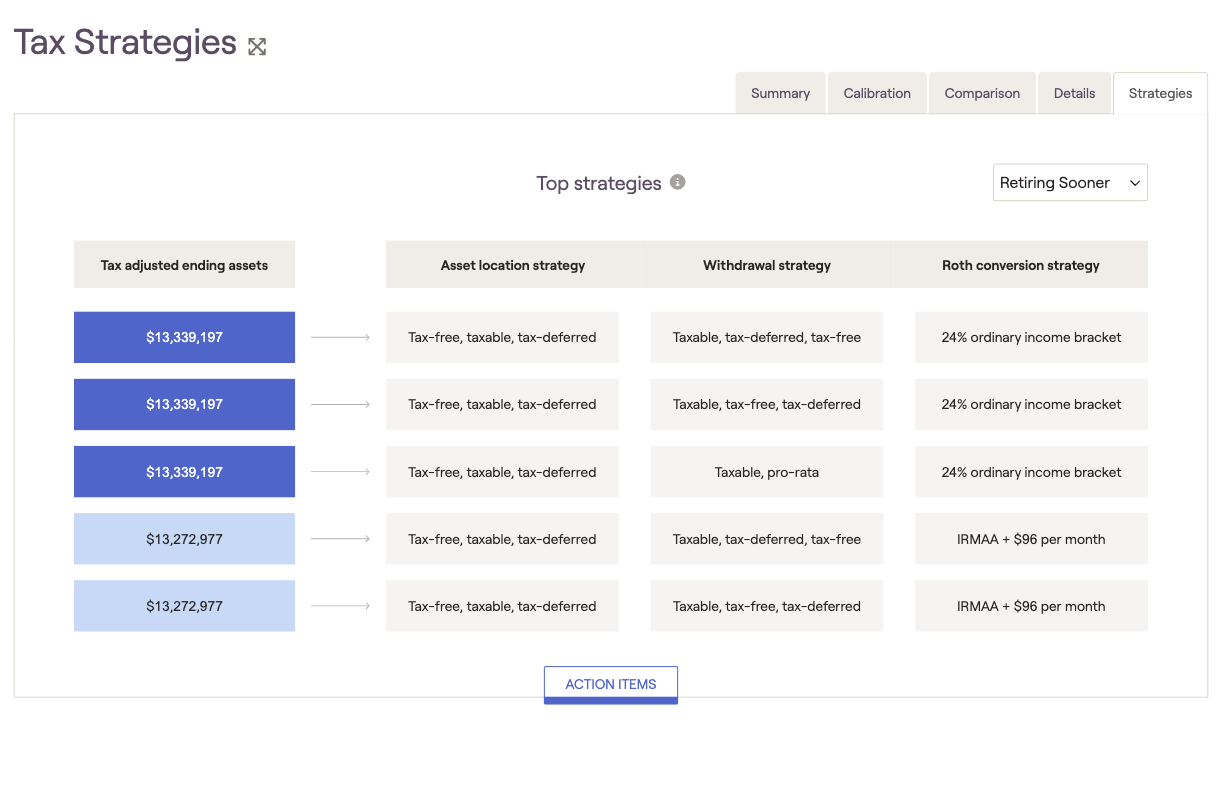
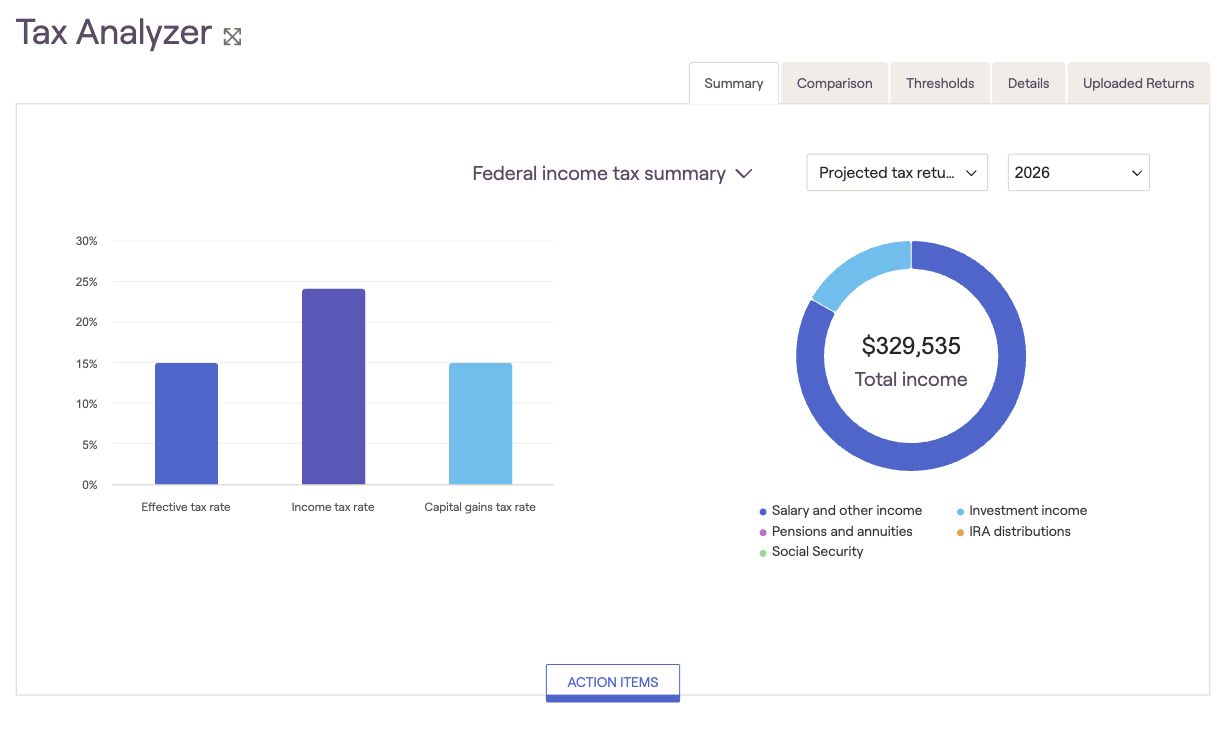
For a firm consolidating its tech stack, that matters. In RightCapital, tax planning, including Roth conversion modeling, is part of all plans, and Tax Analyzer is added at Premium, so there is no second subscription to buy.
Comprehensive planning coverage
This is the clearest dividing line. Income Lab describes itself as "purpose-built for retirement income, not a generalist platform." It has no insurance needs analysis, education planning, student loan or debt module, business or stock plan modeling, or budgeting.
RightCapital covers all of it in all plans: cash-flow and goals-based planning, insurance needs analysis across life, disability, long-term care, and property and casualty, education funding, student loans, business and stock plans, and a dedicated estate module with document checklist, beneficiary tracking, and trust strategy modeling. Budgeting and transaction tagging come in at Premium.
Client portal, visuals, and engagement
Income Lab's Life Hub is a strong visualization. It maps a household's cash flows and net worth for each plan year in a single view, and it works well in a meeting.
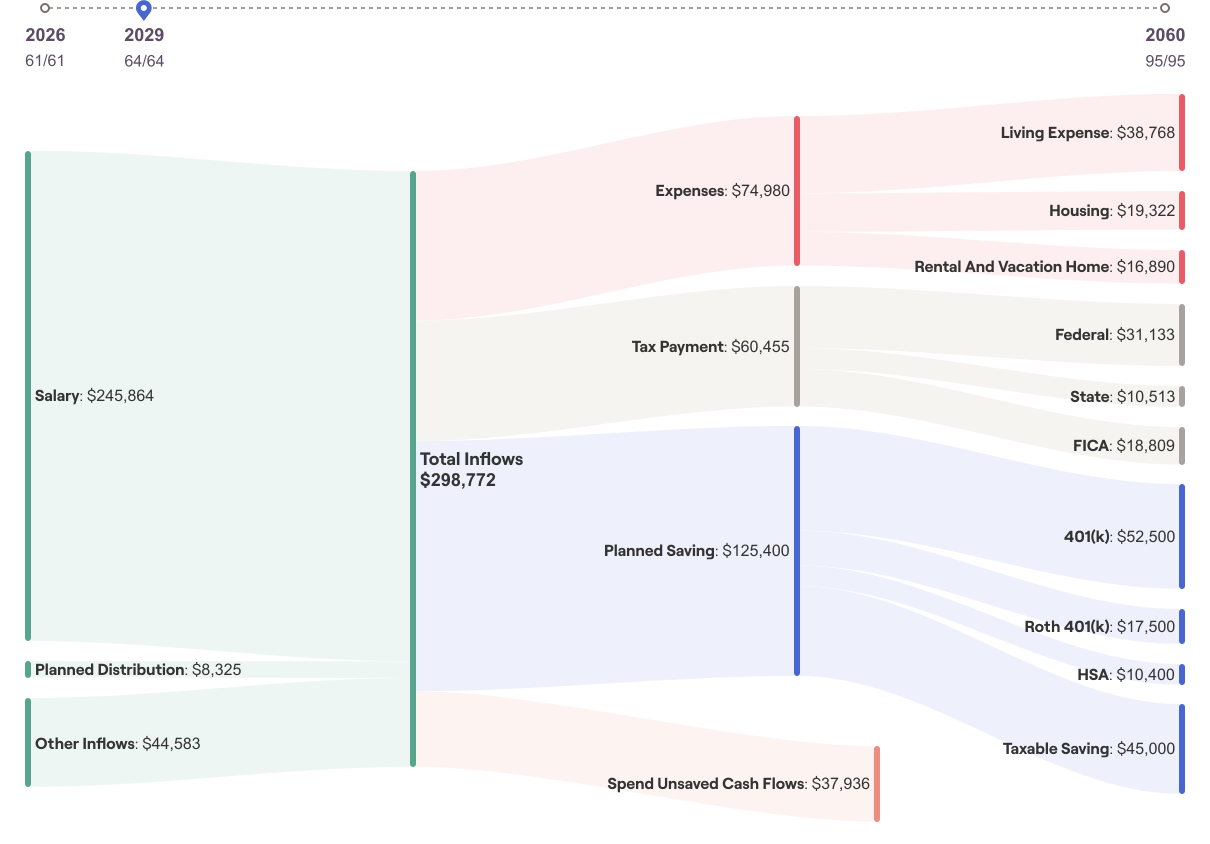
RightCapital gives advisors more ways to engage clients, both in meetings and between them. Blueprint gives clients an interactive view of the household's current net worth, goals, and income. Snapshot is a customizable one-page plan summary built from widgets, with room for personalized notes and images. Cash Flow Maps offer Sankey-style Waterfall and Breakdown charts by plan year. RightCapital also includes tax visuals such as the Tax Income Summary, Ordinary Income Bracket breakdown, and Tax Strategy comparison charts.
Beyond visuals, RightCapital has a strong between-meetings layer: a branded client portal, notes, tasks, a Vault with shared management so an advisor can push a document to every client from one dashboard, and a client-facing mobile app so clients can take their plan on the go or upload documents into the Vault right from their phone. Income Lab recently launched a vault of its own, which is a first step into this territory.
Integrations and connections
RightCapital includes 40+ integrations (including CRMs, portfolio analytics tools, asset custodians, performance reporting platforms, and more) while Income Lab lists 15+.
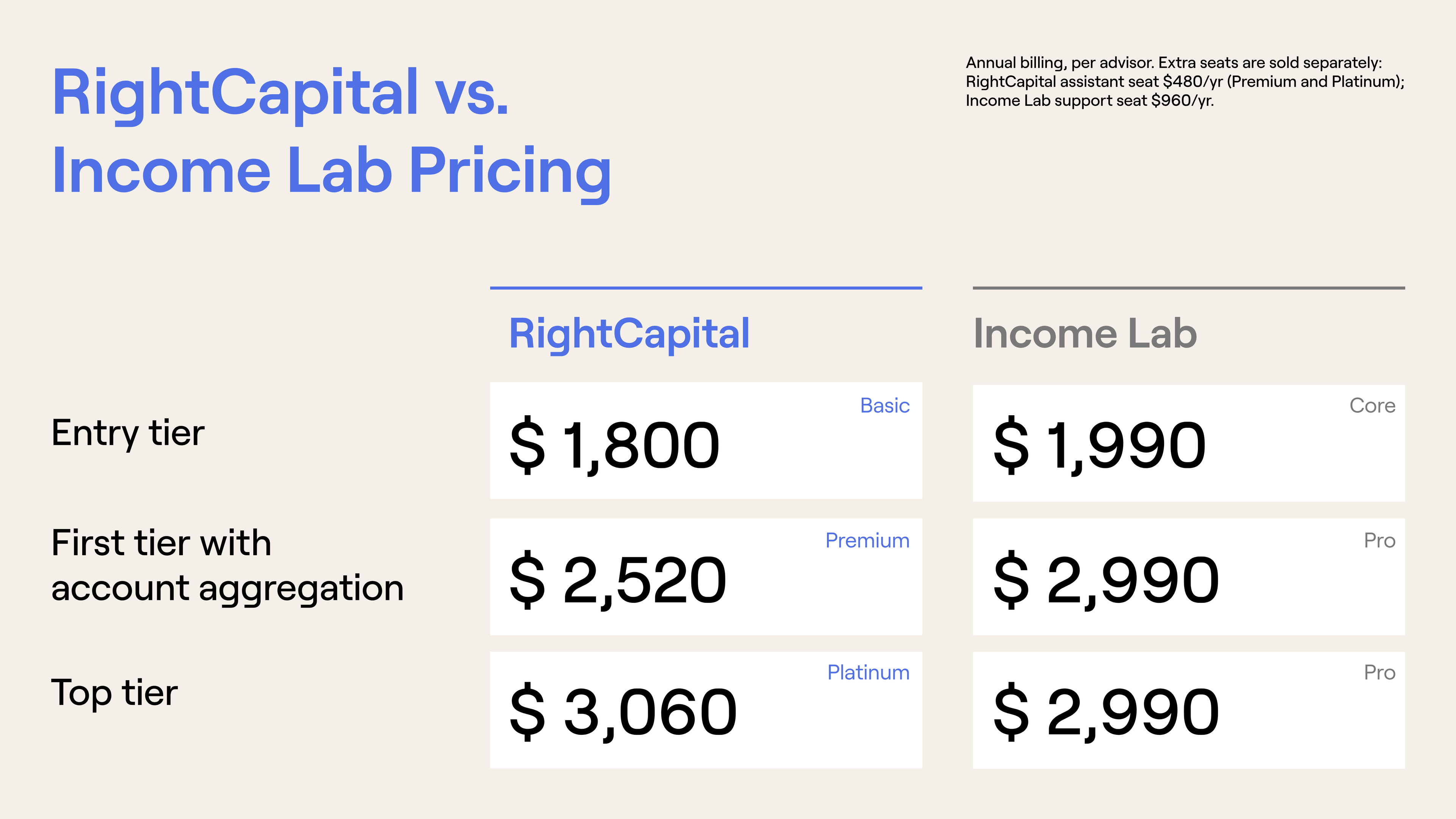
Account aggregation is included with RightCapital’s Premium subscription ($2,519.40 a year) and with Income Lab’s Pro subscription ($2,990 a year).
Why RightCapital works as a foundation
The case for RightCapital is consolidation: one platform that covers retirement income alongside tax, estate, insurance, education, and business planning. Pricing supports that case, especially when you compare tier by tier and factor in team seats.
 Data migration and Smart Import
The honest version of the switching cost conversation is that it’s not as painful as it used to be, in either direction. Income Lab Pro, using their Penny AI, builds a plan from old plans, intake forms, custodian exports, or meeting notes.
RightCapital does the equivalent work with two data import tools. Smart Import uses AI to pull client data from statements, meeting transcripts, or existing plan documents into a new or existing plan. Data Import is built for firms migrating data from eMoney or MoneyGuide, specifically. OCR technology reads the plan PDF reports downloaded from those platforms and maps the fields directly into RightCapital.
Migration is roughly even between the two platforms as both offer tools that use AI to turn existing plan documents into a new plan, with the OCR technology from RightCapital focusing on translating data from the other two leading financial planning platforms. This all means that transition time and effort is no longer a good reason to stay on a platform that does not fit your firm since far less needs to be re-keyed by hand.
Support and onboarding
RightCapital's support team is 100% human and in-house, available via phone, email, chat, or scheduled calls. Dedicated onboarding specialists help your team get productive without being pulled away from revenue-generating work. Advisors also have access to an advisor Help Center (with an AI Help Center assistant) and webinars for ongoing learning. All of it is included in every subscription.
Income Lab offers live support through scheduled calls, email, and a contact form, along with a help center and webinars. Its onboarding-style training program, the Virtual Academy, costs an extra $199.
See RightCapital in action
RightCapital is the comprehensive platform for advisors serving clients across all life stages. Income Lab is a specialist tool for retirement income distribution. A meaningful number of advisors use both, and if your practice is purely decumulation and your core deliverable is a monthly dollar amount, Income Lab may genuinely be the better answer for you.
For everyone else (including advisors who need tax-aware decumulation, Roth conversion modeling, estate planning, insurance analysis, prospecting tools, and client engagement in one system), RightCapital is the foundation that grows with your practice.
Ready to see how RightCapital handles your toughest planning scenarios? Schedule a 20-minute RightCapital demo and walk through your own client cases, including retirement income distribution, Roth conversion modeling, and tax-aware withdrawal sequencing.
Frequently asked questions
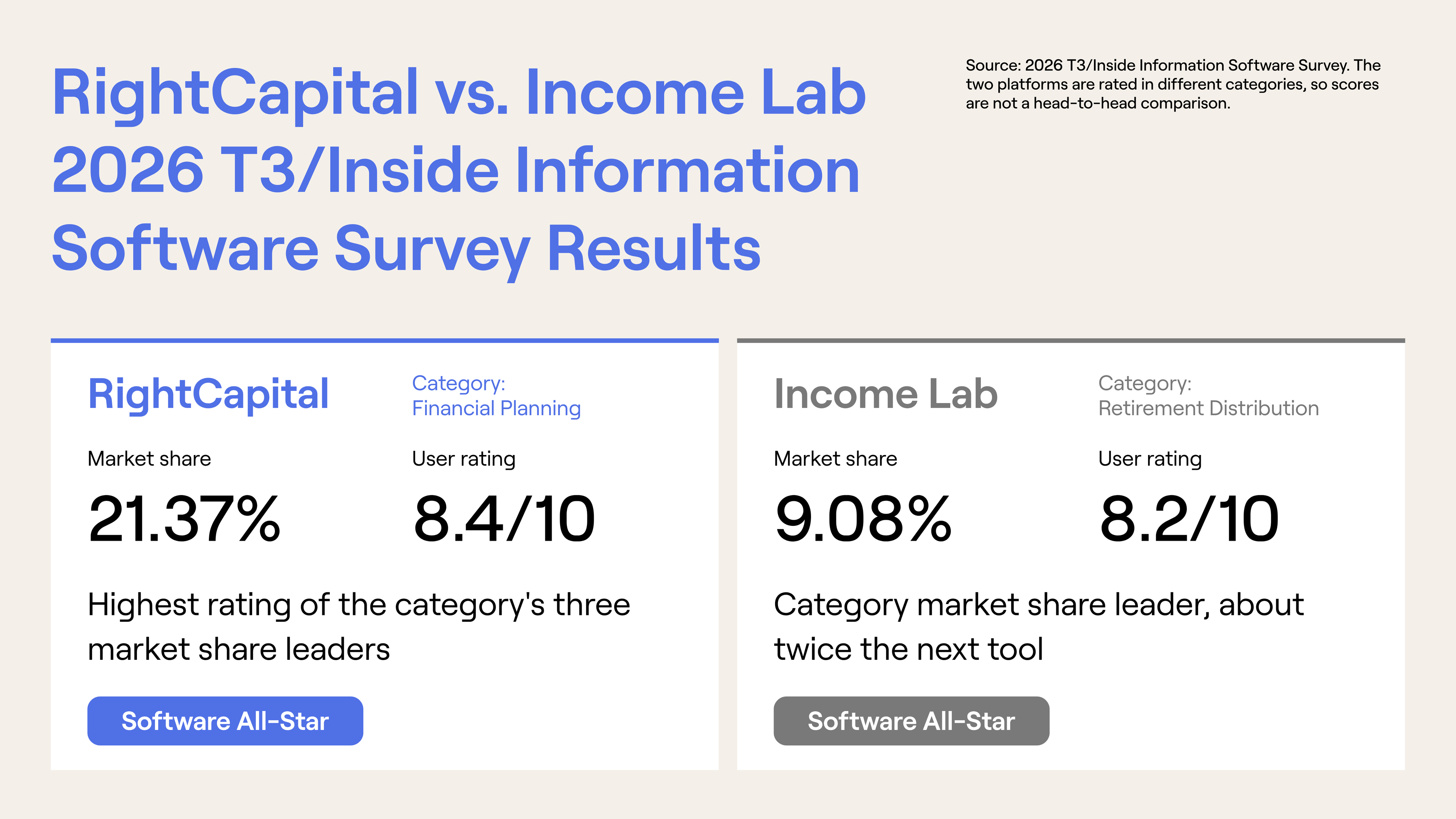
They are built for different jobs, so "better" depends on your book. RightCapital is a comprehensive financial planning platform covering accumulation, decumulation, tax, estate, education, insurance, and more. Income Lab is a specialized retirement income distribution tool. Both scored 8.7/10 in the March 2025 Kitces Report. In the 2026 T3 survey, both were named Software All Stars in their respective categories: RightCapital in financial planning (8.40) and Income Lab in retirement distribution planning (8.20). If your practice spans life stages or you’d like multiple spending strategy options, RightCapital covers more ground. If you are a pure decumulation shop that delivers a monthly distribution figure, Income Lab is purpose-built for that.
Yes. The Kitces Report found that nine in ten Income Lab users use it alongside another third-party application, which it says indicates Income Lab primarily supplements traditional comprehensive tools. Income Lab does not cover insurance, education, or business planning, and its estate tools focus on tax topics such as inherited IRAs and charitable giving rather than trusts. RightCapital can serve as the comprehensive plan of record, with Income Lab layered on for retirement-heavy client segments.
Yes. RightCapital includes its own version of guardrails (based on the Guyton-Klinger decision rules) along with several other dynamic spending strategies, including spending stages, retirement spending smile, and floor and ceiling approaches. RightCapital’s guardrails are triggered by withdrawal-rate movement from a starting rate, while Income Lab's risk-based guardrails weigh a broader set of plan inputs and recompute monthly. One of RightCapital's advantages is that any spending strategy can be tested against two independent gauges (Monte Carlo and cash flow projections with specific return sequences).
The two take different approaches. Income Lab’s Tax Lab models one strategy at a time, either bracket management or withdrawal sequencing, with side-by-side comparisons, and its withdrawal optimizer recommends specific accounts and dollar amounts. RightCapital combines strategies instead. Tax Strategies, included on every plan, models Roth conversions and normal distributions up to ordinary income, capital gains, or IRMAA thresholds, plus asset location and tax-efficient withdrawal sequencing, and surfaces the top five combinations in one click. Tax Analyzer (Premium+) analyzes the uploaded and/or projected tax returns. Because tax planning is built into the comprehensive plan, there's no separate tool to buy.