Advisors' Advice for Switching Software to RightCapital
May 19, 2023

Looking to migrate to RightCapital from eMoney or MoneyGuide? This post may help.
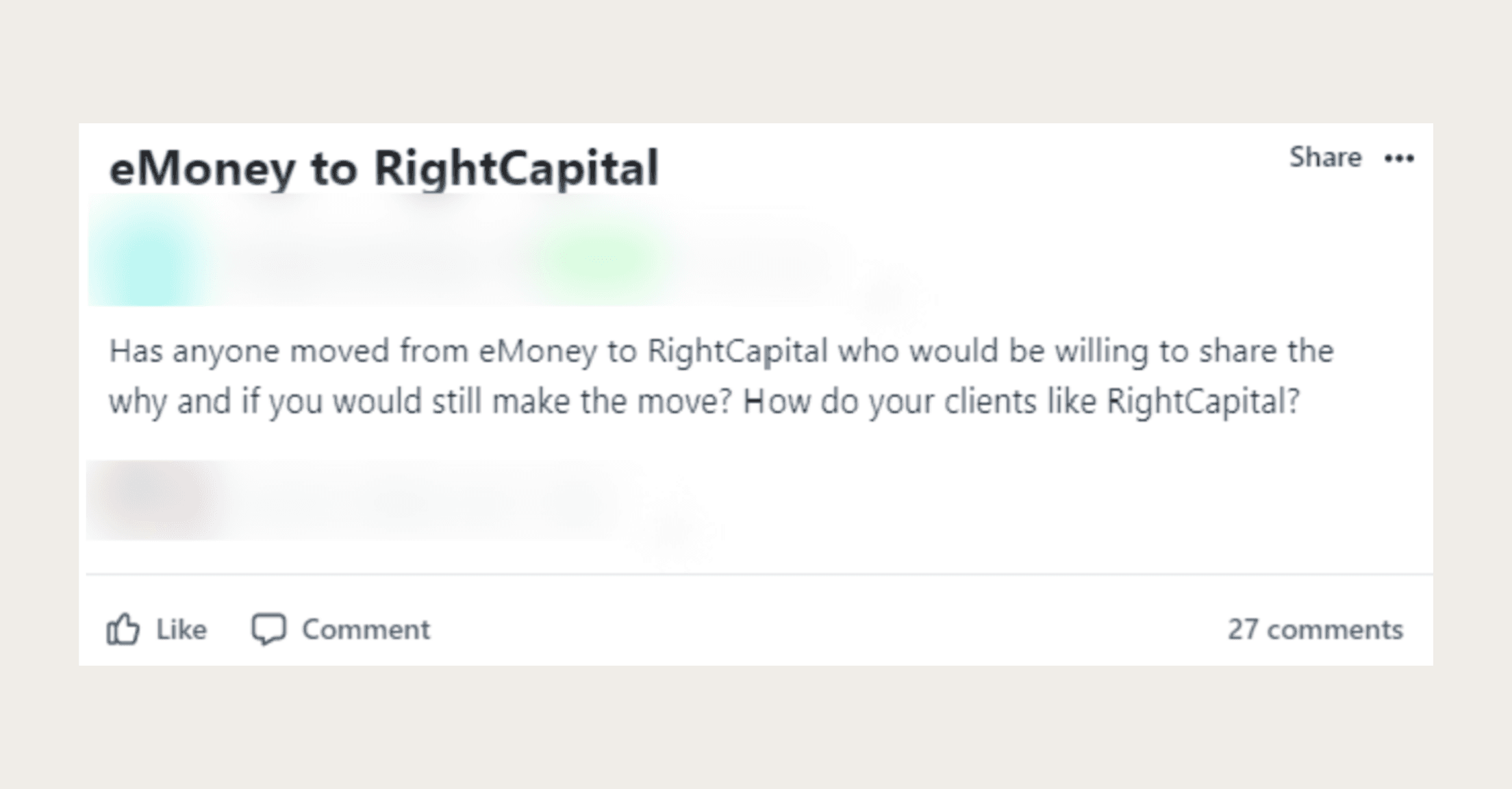
For financial advisors, switching to a new financial planning software is no trivial decision. This topic—specifically switching from “eMoney to RightCapital”—has been so popular in the Good Advisors Finish First (GAFF) online community, that founder John Stadtmueller reached out to us to see if we could help find advisors who had made the switch to RightCapital.
Lisa Grefe, currently Wealth Advisor at Northwest Wealth Management, had written an in-depth article for Advisorpedia last year, “5 Steps to Ensure Your Tech Stack Effectively Serves Today’s Clients,” and Jonathan Kiehl, CFP®, founder of Evenkiehl Financial Planning, had recently posted about his switch from MoneyGuidePro on social media. So we asked them if they’d share their experience—and we’re very lucky they said “yes”!
In May of 2023, John, Lisa, and Jonathan hosted a panel discussion, “Advisor Perspectives: Building a New Tech Stack and Transitioning to RightCapital,” where they discussed the good, bad, why, and how behind switching to RightCapital.
Below are the highlights from the discussion (but you can also watch the full session here).
Why were you looking to switch to RightCapital?
At Lisa’s old firm, they had noticed client engagement was low with their previous software, eMoney. “The feedback was that it was harder to use and visually, it was not as appealing,” for their mostly younger, tech savvy clients. The two focuses for them when choosing something new were improving their client experience and their client engagement. “We found RightCapital more visually appealing, in the budgeting part. They also had a one-page Snapshot…it was a really easy way for (clients) to look at the plan, and not as a big stack of paper.”
John Stadtmueller: So going back specifically to the planning software you mentioned, going back to why it's about the client experience and that you want to have the clients engaged. What are the most prominent things that you saw in RightCapital that maybe you didn't see in eMoney? Was it just that, or were there some other things that you saw? And actually, we want to be as objective. Are there some things in RightCapital that are missing that you may have had in eMoney that you'd like to have had? This could be our ask of RightCapital.
Lisa Grefe: I think a couple things. We'll start with eMoney. We really like the decision center on the advisor side, being able to put in different things that can happen to clients and see what that looks like. At the end of the day though, we found on the client side that wasn't as important to them, what they were seeing. And so in RightCapital, we had a lot of cash flow, so we were doing a lot of budgeting with clients. A lot of cash flow. Can we buy a house? We're in that kind of stage. Buy a house, family, college, savings. So we found RightCapital is more visually appealing in the budgeting part. They also had a one-page Snapshot. And I know eMoney was moving to that. So that was a really big thing where we could just put on one page what their asset allocation was, the plan, we could add notes. So it was a really easy way for them to look at the plan right there and not see a big stack of papers, or email them a big stack of papers, which was really important. But we found once we switched to RightCapital, the budgeting part, our clients were more engaged. We had a number of clients. Not everyone's going to use the budgeting tool. We just know that we definitely had more people using it, keeping track of their monthly expenses. And we had a budget set for them and things like that. And then the one page Snapshot was a big thing for us. And I know they just came out with a couple different visuals of cash flow over time. And that's really cool. People are liking that as well. So some of it's visual appeal, some of it is just on the advisor side, the engagement, the use. And we were using it more, clients were using it more. So we found that would be a win-win.
Jonathan had used MoneyGuidePro at a previous firm before starting his own RIA and had found it to be more of an advisor tool. “We would trot it out during client meetings and it would be this great, impressive plan that we would show clients and if they wanted any more information, we’d print out a 60-page report and send them on their way. That didn’t really sit well with me and I wanted something that was a little bit more client-facing or client-first. In looking at RightCapital, the two things that really stood out to me were the cohesiveness of the platform and the visuals.”
Jonathan Kiehl: We were using MoneyGuide Pro and I decided to go with RightCapital. I spent a lot of time analyzing that just in regards to the fact that I was really looking for more client engagement.
The experience that I had with MoneyGuide Pro was that it was really kind of an advisor tool and we would trot it out during the client meetings and it would be this great, impressive plan that we would show clients and if they wanted any more information, we'd print out a 60 page report for them and send them on their way. That really didn't sit well with me.
I wanted something that was a little bit more client facing or client first. Because I wanted the financial planning software to be a tool that I was using and not the actual financial planning.
In looking at RightCapital, the two things that really stood out to me were the cohesiveness of the platform and some of the visuals. That's what pointed me more toward RightCapital than MoneyGuide Pro.
He went on to discuss the cohesiveness. “You have the account aggregation, the secure document vault, the mobile app, and it’s all a cohesive interface. It looks the same whether I'm presenting a financial plan, or whether clients are logging into their client portal to see their net worth statement, or to do some work with the budgeting tool. It’s very familiar to them, it’s not this foreign thing when they come into a financial planning meeting…When I was with MoneyGuidePro, a lot of the things were add-ons, so we could add on account aggregation, but I think we were using a third-party aggregator, it looked different, our client mobile app looked different, it was a little disjointed.”
When discussing the visuals, Jonathan shared his screen to dive in more into Snapshot, Blueprint, and Cash Flow Maps. We’ll let the visuals speak here:
Johnathan Kiehl: I do want to share just some of the visuals that Lisa mentioned because that was one of the biggest things that I really feel like RightCapital is so proactive in updating, and providing these visuals. At times it's even hard to keep up with it.
So she talked about the Snapshot. The Snapshot's really nice in that it is like a click and drag type thing. You can adjust. You can add text boxes here. For my clients, I created a template. The top one is their financial values, a financial value statement or financial statement of purpose. You can put the balance sheet there, the probability of success for their plan, net worth, different goals that they have, asset allocation. There's a number of different things that you can put on here to customize it, how you want it to look for your firm. So that's a tremendous thing that the clients can, on a one-page summary, get a quick Snapshot of their finances.
And then some of the other things that are really neat are the Blueprint. They rolled out Blueprint, net worth Blueprint. So you can see dividing up the different assets not only by owner, so joint or individual ownership, but also color coded by what type of investments they are. Bank, stock or investments, credit card loans, so liabilities, and insurance. Also doing the same thing with income, savings, and expenses. Really neat visuals that clients can quickly get. A lot of clients are more visual than we like to think. So these are alternative ways to communicate their financial position with them.
And then the cash flow chart that they most recently rolled out, that Lisa was talking about, is like one of these Sankey cash flow charts. That's just another neat visual way of breaking down where's the money coming from, where's it going to, and what's our excess cash flow. So those things, I would say, are things that it's not the geeky, hey, we can do all these data inputs, but it's just a very quick, nice way to communicate a specific point to a client.
And also, once you've got the account aggregation, there are, like any other aggregation platforms, issues with connections being broken. But once you have those connections in place, once you've got the initial data inputs in place, all these charts are updated live. So account balances go up or down, the accounts automatically update, and you don't have to be in there changing anything for an upcoming client meeting. So the visuals are just a great aspect, I feel, for RightCapital.
What happened after you switched?
Lisa noted that once her firm moved to RightCapital, “Clients were more engaged; more clients were keeping track of their monthly budget. The one-page Snapshot was a big thing for us. They just came out with a couple different visuals of cash flows over time and that’s really cool and people are liking that as well.” In general, “We were using it more and clients were using it more, so we considered that a win-win.”
For Jonathan, “The decision has been validated a number of different times with clients…I talked to a client who I am transitioning to a different custodian…he just wanted to know, ‘do I still have my client portal with RightCapital,’ so that was the most important thing for him, to have that. That’s always a great validation, when a client is that invested in the software you’re using.”
Jonathan Kiehl: I feel like it has. That decision has been validated a number of different times with clients. Most recently, just this past month, I talked to a client that I'm transitioning to a different custodian that we've worked with on the financial planning side. Now he's moving his assets over, so we're moving to a different custodian for him. And his only question really was not about the dynamics of moving the assets. He just wanted to know, do I still have my client portal through RightCapital? That was the most important thing for him, to have that. That's always a great validation when a client is that invested in the software that you're using.
John Stadtmueller: I love that. Goes back to Lisa talking about the why and focusing on the client. It's not to say that the robust plan, all these things aren't valuable. It's just a matter of what's going to actually help the client be engaged and move the needle. So I love that. That's really cool to hear.
What do you miss about your old software?
Lisa shared, “We really liked the Decision Center in eMoney, on the advisor side, to be able to put in different things that could happen to clients and see what that looks like, at the end of the day, though, we found on the client side, that wasn’t as important to them.” She continued, “I think eMoney is a very good software…it just became ‘what’s right for our firm?’”
John Stadtmueller: Again, objectively speaking, and maybe trying to help push the needle at RightCapital, what do you miss at eMoney? What are they maybe missing at RightCapital that could help them continue to grow or compete in that space? Are there any big things that you miss from the previous software?
Lisa Grefe: I think the decision center has some unique qualities to it where you can really dig in deeper than RightCapital, if you really want to nerd out on the advisor side and geek out about stuff, cash flow, get really deep into some scenarios.
John Stadtmueller: A lot of advisors want to do that. Then going back to the why, the client experience, how many clients want to do that?
Lisa Grefe: Right. So that's where our why had shifted. We had shifted more to the client perspective. But again, if that's really important to the advisor, then that may be reason to be somewhere else. For us, that became not as important as client experience, client engagement. I use eMoney too. I was in the FPA externship and we got really deep into eMoney as well. And I liked it. I think it's a very good software. It just became what's right for your firm. And I think that's the biggest question that advisors need to ask.
Jonathan agreed with Lisa that what he missed about MoneyGuidePro was on the advisor's side. “The parts that I miss are more, ‘This is kind of a fun, geeky thing for the advisors to play with.’ MoneyGuidePro has their Play Zone, where you can stack four different plans and play around with lots of different data points and see how it affects the numbers…but I only ever had one client use it, because they just weren’t interested in it.”
John Stadtmueller: And what would be, are there things that you miss from MoneyGuidePro? Are there things that you would like to see RightCapital add that you miss, or maybe even the clients miss? Speaking of that client who came to you and asked about, do I still have my portal?
Jonathan Kiehl: I would concur, and I'm not familiar with eMoney as much because I haven't used it, but I would concur with Lisa. Parts that I miss are more of the, hey, this is a fun, geeky thing for advisors to play with. MoneyGuidePro has their play zone, where you can stack four different plans. I think it's four in a row. And you could play around with lots of different data points and see how that affects the numbers. For an advisor, that was really fun. I enjoyed that. I only ever had one client...
John Stadtmueller: That's what I was going to ask. Did you have clients actually doing that?
Jonathan Kiehl: They just weren't interested in it.
Bonus tips!
While you’re here, we’d like to call out some other tips from Lisa and Jonathan on choosing the right tech stack for your business. (It might also help to review popular industry surveys of other advisors, such as those produced by Kitces and T3.)
Lisa mentioned that she sat in on a lot of demos, to really get a feel for each platform she was evaluating. Many companies offer a trial as well—RightCapital is available for free for fourteen days after the demo.
Consider which systems each planning software integrates with, especially if you’ve already fallen in love with your CRM or custodian, for example. Jonathan spoke about how his custodian integrations with RightCapital “have been flawless…there’s been no issues whatsoever.”
Lisa also recommended thinking about the future: “Where you are now is important, but also consider the future of the firm, where the industry is going, and what that is going to look like for you and your team.”
For more on Good Advisors Finish First, visit their website. For more on RightCapital, schedule a 1:1 demo with one of our product specialists.
%3Aformat(webp)&w=3840&q=75)
%3Aformat(webp)&w=3840&q=75)
%3Aformat(webp)&w=3840&q=75)